

-- ' 40m06001.118,10Pff"PRINIPPlaagalmagi
...
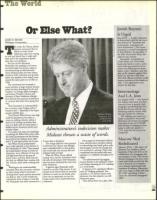
Or Else What?
Jewish Boycott
Is Urged
Bern (JTA) — A right-wing party
in Switzerland called for an imme-
diate boycott of "American and
Jewish goods, restaurants and
travel cle.stinations.” The request
prompted a criminal investigation
of Rudolf Keller, the president of
the Swiss Democratic Party, who
called for the boycott.
Meanwhile, shareholders in
Credit Suisse, one of the Swiss
banks that failed to reach a settle-
ment with representatives of sur-
vivors over Holocaust-era claims
before a July 1 deadline, said they
plan to file a lawsuit against New
York City and New York State.
New York officials said they would
impose sanctions on the banks on
Sept. 1 if an agreement is not
reached by that date.
JAMES D. BESSER
Washington Correspondent
his week, the Clinton admin-
istration announced that its
efforts to revive Israeli-
Palestinian talks were nearing
an end, and hinted that it might pull
back and let the quarrelsome parties
solve their own problems.
But you can bet Binyamin
Netanyahu isn't quaking in his boots;
the Israeli leader has become adept at
outmaneuvering an administration
whose Mideast policy has been charac-
terized by drift, indecision and periodic
lapses into petulance since Israeli voters
turned the Labor party out of office in
1996.
The unevenness has increased in
recent months, in large measure because
policy has been dominated by the poll
watchers, not foreign affairs strategists,
and because President Clinton and
\ --) Secretary of State Madeleine Albright
/— have limited their personal involvement
in a process that hasn't been going their
way.
Their frustration is understandable,
but a reactive, angry foreign policy is
bound to fail — especially in the hyper-
sensitive Middle East.
The Clinton White House wins high
marks for persistence, but when it
comes to crafting coherent policy, it
,— seems to be coming up shorter than
ever as it deals with an Israeli leader it
dislikes and an American Jewish com-
munity it fears.
U.S. policy was clear and unambigu-
ous during the Rabin-Peres years, when
the Israeli government was the driving
force behind the Mideast peace talks
and U.S. and Israel policy was in sync.
But White House policymakers
never really adjusted to the election of
Mr. Netanyahu in 1996. They misread
the Likud leader's victory as a kind of
aberration, not a reflection of very real
and legitimate fears on the part of
Israeli voters, and they didn't hide the
fact that top officials here, starting with
Mr. Clinton, didn't relish working with
him.
Washington was understandably
frustrated when the new prime minister
set about doing what he promised —
slowing down a peace process many had
lost faith in. But it acted timidly and
indecisively when it began to look like
Mr. Netanyahu was more interested in a
Intermarriage
And L.A. Jews
Los Angeles (JTA) - The Jews of
Los Angeles intermarry less than
American Jews in general, their
synagogue membership has risen
in the last 20 years and the over-
whelmilig majority remain with
the same spouse for a lifetime.
The findings were based on a
study conducted by the Jewish
Federation of Greater Los Angeles.
One-third of the city's 519,000
Jews belong to synagogues, com-
pared to only one-quarter in
1979, when the last survey was
conducted.
-
President Clinton
hints at a U.S. -
pullback from
peace talks.
Administration's indecision makes
Mideast threats a waste of words.
U-turn than a slowdown.
The change called for more personal
involvement by Clinton and Albright
and a redoubled effort to find policies
that would take into account the new
political reality in Israel.
What the White House offered
instead was a reactive, sometimes churl-
ish style of interaction with Netanyahu
that may have reinforced his most stub-
born tendencies.
It ignored signs Netanyahu really
wanted to end the Oslo process. It sent
special envoy Dennis Ross on countless
missions to work out the details when
there was no agreement on even the
broad outlines of an Israeli-Palestinian
settlement.
Encouraged by Netanyahu's obfusca-
tions, administration members refused
to acknowledge that Israeli policy really
had changed, and that the change had
not occurred in a vacuum. Then, they
complained that the stalled talks were
sapping U.S. credibility throughout the
region.
The administration's zig-77gging
became frenetic as the stalemate contin-
ued, further battering the U.S. standing
-
as a world leader.
In January, U.S. negotiators offered a
series of "bridging proposals" that
included a 13.1 percent further rede-
ployment, but then played a coy, self-
destructive game.
They denied there was a plan, then
Moscow Shill.
Rededicated
Moscow- (JTA) — The mayor of
Moscow, Yuri Luzmwv, joined
hundreds of the city's Jews at the
'cation of a synagogue that
robed in May. The Marina
ue has been reno-
yr
•A '
• .3,
•t
WhO
$2 or
Lazar, the a
0.
9s
4 ~ S
rabbi.
7/17
1998
35