

has done with Judaism, acquiring,
managing and expanding.
"I sat through a Yom Kippur ser-
vice at Shaarey Zedek and had no idea
what was going on," he recalled.
"Someone recommended Ohr
Somayach. I'm now on their board. I
started studying Torah with Rabbi
Eric Krohner once a week. That had a
huge impact on my life. I loved the
\ history, loved the Jewishness of it."
Hooberman started attending
Shabbat services weekly, and noticed
that "I was one of few young people
there under 40. There aren't many
young people who want to go. I
decided I've got to go, learn how to
daven. I need to know so I can pass it
on to my kids." That's where it all
began. Hooberman and his wife Sally
_keep kosher and are now actively
involved with various facets of the
community. A few years ago, he called
Federation's Executive Vice President
Bob Aronson and asked how to get
involved with Federation. What
seemed like minutes later, Hooberman
was included on committees, became
a board member, and now his most
pressing goal is to work with the
--Kesher Committee, the young adult
version of Shalom Detroit.
-
/-
"I sat through a
Yom Kippur
service at Shaarey
Zedek and had
no idea what was
going on."
Hooberman sits on the YAD board
>i-Ind on the New Leadership board of
Israel Bonds. He's also part of a team
that is forming a metro Detroit alum-
ni association for the University of
Michigan Business School.
"I'd say there's a lack of leadership,"
he said. "I think the Federation has all
these programs, leadership develop-
ment — there will be leaders. [But] I
don't know that our generation grew
up as committed to Judaism and corn-
munity service as the previous genera-
tion"
Today's generation has "a different
set of priorities. We just have to work
very hard to develop" a solid leader-
ship base, he said.
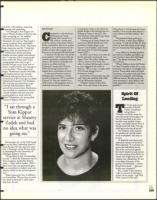
Sari Claire!
.
C
ompared to what she knew
growing up in Grand
Rapids, Sari Ciairei, 32, is
like a kid in a candy store
amid the options of the busy Detroit
Jewish community. And more options
translate to more involvement for the
mother of thme who jumped in feet
first, just as her parents did back home.
"I attribute the fact that I do all this
to my parents," said Cicurel, who has
chaired committees, leadership devel-
opment, the division Campaign and
served as an officer with the
Federation's Young Adult Division
before becoming president (she
stepped down as president in June).
A telecommunications major at
Michigan State University, Cicurel
moved to Detroit in 1987 to work for
Channel 56. She later worked fora
cable system in Birmingham then as
marketing director for the Jewish
Community Center, a job which she
landed thanks to her involvement as a
Federation liaison to the JCC. She
went freelance when she became preg-
nant with her first child.
"Growing up in Grand Rapids, the
way to have Jewish friends was to be
involved in Jewish things, to go
beyond Grand Rapids," said Cicurel,
who was active in United Synagogue
Youth (USY).
At MSU, since there were then no
Jewish sororities, she started one,
Sigma Delta Tau. After college, she
tried to move to New York, but
when her plans fell through a sorori-
ty sister suggested she move to
Detroit "When I did, a couple older
USY friends dragged me to
Federation events.
Involvement, Ciairel said, was "nat-
ural." She's also involved with JARC
and the Weitanann Institute.
"I believe wherever I live, that's
where I live, and I have to do some-
thing about it. And because of my per-
sonality, I have to tell others about it. I
want others to feel this passion," she
said
Her husband Mitch grew up in
metro Detroit, as their three children
are doing. "I really do feel like if I don't
stand up and raise money to do things
for our community, who's ping to do
it?"
A key difference between previous
generations of leaders and today's up-
and-coming is that a few individuals
gave "big clumps of money then,
Circurel said
"What's different about Joel Tauber
or David Hemielin is they are so corn-
passionate and back it so strongly with
money. Young adults today are asked
for money in so many areas, and from
a financial standpoint were making
different money. We have to do a lot
more education. I don't think its the
older generation's problem -- it's our
problem." Li
Spirit Of
Leaditg
T
he Torah gives several
examples of Jewish
leaders, the greatest
being Moses.
"Probably one of the many fea-
tures that made Moshe great was
that he's described as the most
humble, most modest human
being," said Rabbi Steven Weil of
Young Israel-Oak Park "His ego
didn't get in the way of his job."
Two Hebrew terms describe
the qualities of a Jewish leader:
ro-eh, or shepherd, and evech or
servant.
"A shepherd cares about each
individual member of the flock,"
Well explained. "A ro-eh does not
ignore the individuals for the
sake of his communal agenda,
but there's sensitivity and concern
for each member of the flock, no
matter how bright they are, how
wealthy, how charismatic. It's not
an accident that some of the
greatest Jewish leaders — Moses,
King David, Jacob — their pro-
fession was a shepherd."
But a leader is also someone
"who is a servant of God and a
servant of the people," said Weil.
"Not a servant of the self."
7/17
1998
103