

luring more than 200 peers to a spe-
ial pre-glow party before the event.
That party continues and has been
joined by several other small events
throughout the year. The young
adults plant flowers at JARC homes
and gather for pool parties, Detroit
Tigers games and Shabbat dinners,
all side-by-side with JARC clients.
"We think it's really important for
*the young-adult volunteers to have
contact with the JARC clients,
because then people can see where
their efforts are going," Jacobson
said.
But she is aware of the competi-
tion for young-adult charity dollars
and" hours. "I think that our genera-
tion may not have as much dispos-
able income, and so they're taking
ime and analyzing where they want
their money or volunteer efforts to
go. Maybe because young adults
right now don't have a lot of time
and money — people are starting
families, and they get information
from a lot of charities in the area, so
they really have to be discriminating.
There are so many young adult
groups that they can't do it all, time-
ise and financially."
"I think it's a
very important
cause, from
personal
experience."
Jacobson still heads JARC's young
adult committee and also sits on the
JARC executive board. In agreeing to
an interview, she stressed that she
wanted to talk not about herself but
about all the new things the young
adult committee has done.
Namely, there is now an endow-
ment campaign established and
defined by JARC's dedicated young
adults. With a kickoff fund-raising
event in June at the Oakland Grill in
Birmingham, the committee's efforts
are going toward establishing an
ongoing fund that will provide for
services for disabled children.
"We're the future leaders of JARC,
and we're providing for the future of
JARC," Jacobson said.
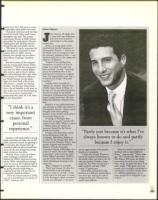
Joshua Opperek
osh Opperer, 28, glides into
a room with ease, deflecting .
attention from himself by
redirecting it to the people
around him.
Dozens of young adults newly
involved with Jewish Federation of
Metropolitan Detroit — who sit on
the board, serve as co-chairs, or sim-
ply volunteer volumes of time — are
involved solely due to the urging and
influence of Opperer.
"Instead of me chairing three
committees, my goal is to find six
people to co-chair who have not
been involved," he said. "I just hap-
pen to be somebody who at this
point is more involved on a regular
basis. The responsibility with that is
to branch out and get 100 people
involved."
Leading comes naturally fbr
Opperer, an attorney with the firm
of Jaffe, Raitt, Heuer & Weiss. At
the age of 8, he was soliciting contri-
butions by phone for the Jewish
Federation of Metropolitan Detroit's
Super Sunday fund-raiser. His own
father had solicited a donation from
him.
Raised in a very traditional home
and schooled at Hillel Day School of
Metropolitan Detroit, Opperer never
thought much about getting"
involved in the Jewish community; it
was just the thing to do.
In college at Michigan State
University, he became 'peripherally"
involved with Hillel. While a student
at Wayne State's law school, he
immersed himself in the Detroit
Jewish community.
It began with Federation, which
led to. involvement with the
Campaign, Rekindling Sha.bbat as
co-chair for the Young Adult Task
Force and the Ethiopian Project. Last
month, Opperer was honored by
Machon ETorati, the Jewish
Learning Network of Michigan, as a
person to watch. He is also "deeply
committed" to the American Israel
Public Affairs Committee (AIPAC),
and the Think Twice Foundation,
which rehabilitates housing in the
inner city.
Why is Opperer so involved?
"Partly just because it's what I've
always known to do and partly
because I enjoy it," he said. "It defi-
nitely makes me feel good. I certain-
ly have developed a good network of
friends and colleagues. It also gives
WWWINRA.
II
"Partly just b ecause it's what I've
always known to do and partly
because enjoy it.
"
me the opportunity to be creative,
hands-on in programs.
"I think that, clearly, Detroit is
one of the luckiest communities in
the world, when you look at the vol-
ume and quality of leaders. Some
stand out, but when you get just a
little involved, you hear 1,000
names," Opperer said.
The Jewish community today,
however, is a different animal than it
was years ago, making the task of
raising money and volunteer time
much more difficult.
"Now, the Jewish community is
involved with so many different
things," Opperer said. 'Thirty years
ago, when the Six-Day *War or the
Yom Kippur War came, the whole
community focused on one thing.
Now, things are good, the focus is on
other things. That's great, but even
people who are deeply committed to
community, its hard to attract them.
It's a different generation; not as
many people feel as obligated to par-
ticipate."
7/17
1998
101