

PETER EPHROSS
Special to The Jewish News
I is an absurdity that Franz Kafka
himself would appreciate. Some
1,500 people recently crowded
into New York's Town Hall for
an evening devoted to a new transla-
tion of an unfinished hovel that its
author, now dead, had asked not to be
published.
As Pulitzer Prize-winning journalist
David Remnick-put it as he opened
the event, which celebrated the publi-
cation of the new translation of
Kafka's The Castle: "Good evening.
I'm about to utter a sentence I never
thought I would open with. Welcome
to Kafka night at Town Hall."
The hoopla surrounding the novel,
which concerns a land surveyor who is
unable to receive instructions from his
superiors in a new town — let alone
survey any land — is only one exam-
ple of the blossoming popularity of a
writer who so perceptively character-
ized the banal evil that lurks in
labyrinthine bureaucracies.
Three months after its first print-
ing, the new translation of The Castle
has already sold out, said Arthur
Samuelson, at Schocken Books in
New York. The book is already into its
fourth printing which is unusually fast
for a literary novel, according to the
publisher.
"People love Kafka," Samuelson
said simply.
.
Kafka, who died of tuberculosis at
the age of 41 in 1924, was as aggres-
sively self-critical as he was brilliant.
The Czech author left his writings —
including his great novels The Castle,
The Trial and Amerika — in the hands
of his friend Max Brod with instruc-
tions that they be burned.
Brod declined to set fire to his
friend's oeuvre, but he did do some
damage in preparing Kafka's texts for
publication. Yet despite some poor
translations of his work, Kafka has
long been considered one of the great
writers of the 20th century — a
prophet, many say, of some this centu-
ry's most horrific events.
History itself has contributed to the
renaissance. During the Communist
era, Eastern European authorities
often limited the dissemination of
Kafka's works. When they did allow
them to be distributed, officials sup-
pressed any interpretations that didn't
support the ideology of their regimes.
Peter Ephross writes for the Jewish
Telegraphic Agency.
The Kafka
'Craze
The great Czech writer remains
timely in today's often absurd world.
Since the fall of the Berlin Wall in
warning against historical events? My
1989, Eastern Europeans have discov-
answer would be that history in a way
ered — or rediscovered — the author
outdid Kafka, outdid his worst night-
of such works as "The Metamor-
mares. It's placing too much of a bur-
phosis," in which the protagonist,
den on a writer to ask him to be a
Gregor Samsa, wakes up to find him-
prophet."
self transformed into a bug.
Kafka, whose characters are con-
In Kafka's native Prague, where his
sumed by futile but unavoidable
work -was long banned,
predicaments, may be benefiting
there are two bookstores
from the same increased interest
devoted to his writings
in pre-World War II European
— one that sells his
books in Czech and one
that sells them in
German. In recent
years, Kafka memorabil-
ia has been sold on the
streets in the Czech cap-
ital — items ranging
from T-shirts to bronze
statues to, yes, even
plastic souvenir replicas
of his pointy ears.
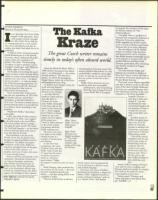
Above: Franz
There's a Kafka museum Kafka: The early
in the Czech capital,
20th-century
Seinfeld?
and posters advertise
Kafka walking tours.
.
Of course, not every- Right: Mark
Harmon's new
one believes that Kafka
English translation
should be seen as a
prophet of communism of "The Castle"
maintains the
and Nazism.
relentless, edgy
At the New York
quality
of the origi-
symposium, the writer
nal
German.
Cynthia Ozick said that
Kaflca "had no idea that
17 years later his sisters
would be tortured to
death in a German
A NEW TRANSLATION, BASED ON THE
penal colony." Kafka,
she argued, would have met the same
Jewish culture that has sparked the
fate.
revival of interest in klezmer music
Mark Harman, who translated the
and Yiddish language.
new version of The Castle — the work
Of course, the extent of Kafka's
has been translated several times
Jewishness has long been a subject for
before — said that asking Kafka to be
debate. Kafka "regarded himself as a
a prophet is unfair.
person writing in German," and not
"Can his work be seen as advance
as a "Jewish writer," said Stanley
Corngold, the translator of the popu-
lar Bantam edition of "The
Metamorphosis."
Corngold, who is a professor of
German and comparative literature at
Princeton University, added that
Kafka regarded non-Jewish writers
such as Gustave Flaubert and Fyodor
Dostoyevsky as his main influences.
But the influence of the Yiddish
theater on Kafka's works has been
well-documented, and it is known
that Kafka became increasingly attract-
ed to Judaism in his later years. He
studied Hebrew and flirted with
Zionism, particularly after witnessing
anti-Semitic incidents in Prague,
Harman said.
The links between Kafka and
Judaism are currently on display in
New York City at a center devoted to
the history of German-speaking Jewry,
the Leo Baeck Institute.
The Israeli writer Aharon Appelfeld
says that in literary circles in the early
years of the State of Israel, Holocaust
survivors saw a parallel between their
own experiences and that of the main
character in The Trial. Appelfeld —
himself a survivor —
said that in their eyes,
Joseph K. "was the
assimilated Jew who
tormented himself with
the question of what is
wrong with me and
what crime did I com-
mit?"
Another source of
Kafka's resurgent popu-
larity.may lie in his
ability to chronicle,
decades in advance, the
bureaucracy and imper-
sonal nature of the late-
20th-century world.
"One of the central
metaphors that he uses
in his work is that of
bureaucracy, and you
could say that our
world is even more
bureaucratic than his,"
Harman said. "Press 1
for this, press 2 for
>.‘
that. Kaflca would have
RESTORED TEXT
had a field day with
that."
Indeed, Kafka's sendups of bureau-
cracy and his clever wordplay, said
Harman, lead some people to compare
The Castle to the work of a more
recent popular culture icon.
"Some people," Harman said,
"when they hear it read aloud, they
say: 'Seinfeld."' 111
7/10
1998
77