

EDITOR'S WATCH
Museum Directors Intensify
Screening For Plundered Artwork
os-
"The Nazis gathered up the works of
id you ever wonder how art
art
for great repositories."
museums screened prospec-
Jews
were especially targeted. "The
tive purchases to assure
most
avant-garde
collectors of art hap-
authenticity and ownership
pened to be the Jews," Bergman said.
in light of the tens of thousands of
After the war, the Allies discovered
paintings the Nazis plundered from
repositories
in the Austrian salt mines.
the Jews in the Holocaust?
The Allies took control of the artwork
I did. And at a June meeting of the
and tried to trace ownership. "Tens of
American Jewish Press Association, I
thousands of pieces were repatriated
gained some insight. I learned that
—
returned to the country of origin
museums try to be vigilant in their
or to the rightful owner," Bergman
purchases, but only now are they
said.
developing more-stringent acquisition
The world focused on repatriation
methods.
for a while after the war,
"This is a very serious mat-
but recent books affirm
ter. We as an industry need to
that tens of thousands of
understand this issue in a very
pieces taken by the Nazis
profound way," said Dr.
in organized looting or
Robert Bergman, Cleveland
random thefts remain
Museum of Art director, speak-
unaccounted for.
ing on "Ethics of Collecting
With tacit American
Antiquities Artwork."
approval, Russian forces
"In wake of the human
staked their claim to some
tragedy that was the Holo-
of the artwork as repatria-
caust," Bergman said, "there
RO BERT A.
tion. "These works rernalin
was a plundering of the insti-
S KLAR
hotly disputed between the
tutions of the Jews. We need
Editor
German and Russian gov-
to find methodologies to prove
ernments," Bergman said.
where art originates."
Meanwhile, Hitler had lit-
Adolf Hitler was an art buff drawn
tle use for plundered works by artists
to works of Germanic tradition. That's
he didn't like, like Picasso and
what filled the vast art collection he
Matisse. "He insisted that German
built during the height of Nazi Party
national museums take this 'degenera-
power. "He had planned to create the
tive' art and get rid of it," Bergman
world's greatest art museum through
said. "They dispersed it all over the
an organized plunder of all the lands
world in trade for Germanic art or for
he passed through," Bergman said.
very careful to evaluate the history
of a movement as written and sanc-
tioned by the movement itself. For
example, Lubavitch's "history" of the
Rebbe apparently leaves something
to be desired. Primary research on
the Rebbe's years in Berlin and Paris
has long been meticulously carried
out by Professor Menahem Friedman
of Bar-Ilan University and reported
last April in a series of articles by
Avirama Golan in the respected
Israel daily Ha Aretz. This research
demonstrates, for example, that
many of Lubavitch's "historical facts"
about the Rebbe's "secret" years are
legends, without any evidentiary
support. (This should hardly detract
from anyone's desire to laud the
Rebbe's tremendous works and
accomplishments on behalf of the
Jewish people.)
Further, for Rabbi Kagan to
imply the scope of the Messianist
of Art Museum Directors task
force that will toughen purchas-
ing guidelines for the 180 mem-
ber museums. "We want people
who visit museums here or in
Europe, or who look through
museum catalogues, and who
have family documentation
about a particular piece of art, to
come forward," he said.
With U.S. state department
assistance, the association hopes
to develop a database that will
assist in matching known plun-
dered artwork with acquired
pieces That have gaps in owner-
ship history. "Where claims are
legitimate," Bergman said, "we'll
try to settle or agree to media-
tion. It's unbelievably complex to
try to sort out the problems.
Each case is unique."
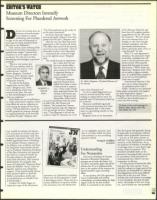
Dr. Robert Bergman, Cleveland Museum of
International exposure is the
Art director.
best way to bring repatriation
for plundered pieces still in
limbo. "Insofar as you ultimately
cash to buy Germanic art."
help inspire cooperation and support
It's this so-called degenerative art
to make repatriation happen,"
that has moved around the world,
Bergman told the Jewish journalists, "I
making its origins hard to track. It's
would have been doubly happy to
possible some of these pieces ended up
come here this evening."
in museums.
Museums worldwide rigorously
screen potential purchases, but some-
times, Bergman said, it still comes
down to a gut feeling whether to buy
a piece of art.
Bergman serves on an Association
are no negligible minority. And
how it was their belief was born
and nurtured is a very troubling
question indeed.
Irving D. Goldfein
Southfield
Understanding
For Netanyahu
-
-movement in Lubavitch is somehow
blown out of all proportion is itself
a diversionary tactic. There may be a
serious difference of opinion within
the movement, but the Messianists
The recent drumbeat of criticism
directed at Binyamin Netanyahu
prompts me to write this letter. It is
not that I necessarily agree with all his
policies, but I try to understand the
man in the context of the situation he
found himself in upon assuming
office.
In my opinion, the Oslo agreement
was an irresponsible and reckless
undertaking, notwithstanding the high
regard I have for the late Yitzhak
Rabin. It was based on the premise
that the leopard will gradually change
its spots and, in the process, embrace
Isaiah's vision of peaceful coexistence.
Let me, at this point, hasten to
add that I am not opposed to ceding
territory to the Palestinians. As to
the question of whether it should be
a sovereign state or some lesser legal
entity, I have no opinion. This
should be decided solely on the
grounds of assuring Israel's security,
in accordance with principles of
international law, which I am not
competent to discuss.
It is the process envisioned by Oslo
that gives me most concern. It pro-
vides for ceding ever larger parts of the
territories, an irreversible act, with the
final disposition of the most difficult
issues left to-the very end. Those
include such vital matters as sovereign-
ty over Jerusalem, the issue of settle-
ments, the borders of the new entity,
etc., any of which can, and probably
7/10
j
1998