

According to Jewish Community
Centers Association Assistant
Executive Director Mitchell Jaffe, the
program endowment is a smart move
for Detroit because it can "underwrite
the cost of maintenance, and protect
their investment," he said.
The plan to renovate Detroit's two
facilities is hardly an original idea in
centers across the United States and
Canada. So far this decade, JCCs have
spent between $450 million and $500
million in building and renovation
projects.
Jaffe noted that Cherry Hill, N.J.,
and Winnipeg, Canada, recently spent
$17 million and $24 million, respec-
tively, on new buildings. Indianapolis,
with a Jewish population of 15,000, is
in the middle of a $15 million expan-
sion and renovation. In December, the
St. Lodis JCC dedicated an 80,000-
square foot satellite facility.
The cost of the Detroit project is
typical for new buildings rather than
renovations, Jaffe noted, but he
believes it is understandable, given the
size of the Kahn Jewish Community
Center in West Bloomfield —
315,000 square feet.
"Detroit's is certainly one of the
most expensive renovation projects,
and because Detroit's center is physi-
cally the largest in the world, it
would cost more to do than most,
he said.
Jaffe estimated that it might cost
$35-$40 million to build a center the
size of the Kahn building.
David Sorkin, the Detroit JCC's
executive director, said the size of the
present facility was a key factor in the
decision to renovate rather than build
anew.
"The $18 million would be enough
to build a new metro center, but that
would be about 120,000 square feet,"
he said. "We can't make what we've
got smaller, just improve."
Plans call for rearranging space to
emphasize areas such as child care,
which wasn't a high priority when the
West Bloomfield facility was built 23
years ago.
Sorkin said the renovated center
would also better meet the needs of
community organizations, not a prior-
ity in the original building.
"Some see it as a place where they
can touch all their constituencies, and
others as a crossroad to get their mes-
sage out to more people," he said.
Fund-raising of this magnitude is a
first for Detroit's JCC, comparable
only to the $28 million raised annual-
ly by the Jewish Federation of
-
"
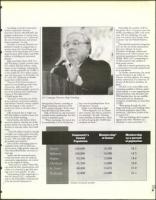
JCC Campaign Chairman Hugh Greenberg.
Metropolitan Detroit, according to
Hugh Greenberg, chairman of the
JCC's capital campaign. So far, more
than $6 million has been raised.
Jaffe, of the JCCA, said renovation
typically boosts membership, but how
much is anybody's guess.
"When renovating, the typical rise
in membership is 25 to 30 percent,
but it can be anywhere from 10 to
100 percent," he said.
Sorkin is not shooting as high.
"We've figured a 15- to 20 per-
cent increase, but that's a conserva-
tive estimate," he said. "Getting
more members is absolutely a need,
as well as keeping the 10,000-plus
members we have."
-
Nationally the number of JCCs
has grown 10 to 15 percent since the
1950s, according to Jaffe, with more
than 100 new buildings. He said
only two centers have closed, those
in Jersey City and North Hudson,
N.J.
The national association categorizes
JCCs by the size of the communities
they serve. Detroit, St. Louis,
Cleveland, Pittsburgh, Atlanta and
Baltimore are all "metro centers" serv-
ing Jewish populations of more than
50,000. With a JCC membership of
10,500, Detroit is the smallest of
those metro centers.
Jaffe said a center's penetration into
a community is inversely proportional
to its population.
"In smaller communities, the center
may be the place to go, where in
Detroit, you have options. In a metro-
politan community, if a center has 15
percent of the Jews as members, it's
good.
The JCC in St. Louis offers some
interesting parallels to Detroit, partic-
ularly because it is now operating two
physical facilities, like the Kahn and
JPM branches here. Its new satellite
center produced an 18-percent
increase in membership, to more than
12,000.
"We're going through the chal-
lenges of having a new building where
the Jewish population hasn't fully
moved yet," said Steve Zucker of the
St. Louis JCC.
"The two buildings don't compete
against each other. Members use
whichever is more convenient."
❑
timore
Atlanta
Cleveland
Louis
Pittsb,irgh
*includes non-Jewish members
6/26
1998
9