

I thought to be a negative reaction to
'Jewish dietary laws.
In another section, Woman
Entering the Water is inspired by a
Rembrandt work showing a woman
bathing. A great admirer and close
observer of the old masters, Soutine
often painted a person or still life
positioned similarly to some histori-
cal rendering that he valued.
"Soutine was trying to see if he
could reinterpret, in modern terms,
the great master paintings," Kleeblatt
says. "He became known as the say-
for of French and European painting
in the face of Dada and Surrealism.
"Soutine proved to the critics that
he could paint with the passion and
intensity that was missing from cer-
tain more radical art movements, and
he wanted to play a role in the more
historical tradition."
Les Gorges du Loup sur Vence, in
the third section of the exhibit, is
highly emotive and rather abstract.
Like his other works in this style, it is
said to be an influence for artists
seeking psychological depth in
abstract expressionism.
Soutine, who produced
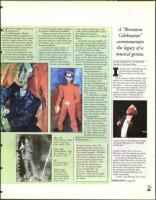
Above, left:
Chaim Soutine: "Man
with a Long Nose,"
oil on canvas, 1921.
8
Zr;
0
Above, right:
Chaim Soutine: "Page
Boy at Maxim's," oil
on canvas, 1934.
Left..
The artist Chaim
Soutine in 1927.
Opposite page:
Chaim Soutine:
"Landscape with
House and Garden
near Paris," oil on
canvas, 1918.
a vast number of paintings in the
1920s, gained considerable acclaim
after being discovered by
Philadelphia art collector Dr. Albert
Barnes.
During the next two decades, he
was supported by influential patrons
Marcellin and Madeleine Castaing.
The last two years of his life were
spent hiding from the Nazis.
"Soutine was a very turbulent
character," Kleeblatt says. "He was
pretty much a loner, very intense and
emotional, complicated and contra-
dictory. He doesn't fit easily into any
category. He doesn't write any mani-
festos, and he doesn't
become part of other
artists' movements.
"He was quite the well-
known artist from the time
Barnes saw his work, and
he was shown at the
Museum of Modern Art in
the '30s. He had gallery
shows in Paris, and he had
gallery shows in New York
from 1936 on.
"I think there is a large
interest right now in the
conviction in his work.
Once the art world turned
from a focus on abstract
expressionism to minimal-
ism, pop art and conceptu-
al art, there wasn't much
space for Soutine to be an
interesting figure."
Kleeblatt recommends
an open approach to view-
ing the Soutine exhibit.
"Soutine can be enjoyed on
so many levels," the cura-
tor says. "People can enjoy
the color, form and tradi-
tionality, and he can be
appreciated head on for all the emo-
tional intensity."
❑
An Expressionist in Paris: The
Paintings of Chaim Soutine will
be on display through Aug: 16 at
The Jewish Museum, 1109 Fifth
Avenue, New York. (212) 423-
3271. Closer to home, the exhib-
it will be at the Cincinnati Art
Museum Feb. 14-May 2, 1999.
The book An Expressionist in
Paris; The Paintings of Chaim
Soutine (Prestel; $65), by
Norman L. Kleebatt and
Kenneth E. Silver, has been pub-
lished as a companion volume to
the exhibit.
A "Bernstein
Celebration"
commemorates
the legacy of a
musical genius.
ALICE BURDICK SCHWEIGER
Special to The Jewish News
I
t may be just a coincidence, but
Lincoln Center Festival '98
planners admit it's a fortuitous
one.
Each summer, Lincoln Center pays
tribute to a renowned composer, and
this year's honoree is the late Leonard
Bernstein — who just happened to be
an early and active supporter of Israel.
"We selected Bernstein before we
began to put our program together,"
says Janice Price, vice president of
marketing and communications at
Lincoln Center will celebrate the legacy
of Leonard Bernstein in a "Bernstein
Celebration."
Lincoln Center. "As it turns out,
Bernstein, with his strong connection
to Israel, was a very fitting choice."
According to Michael Barrett, who
studied under Bernstein, served as his
assistant and is now music adviser to
the Leonard Bernstein estate and
director for the Lincoln Center event,
the composer would have been
thrilled to be honored along with
Israel's anniversary.
"In fact," says Barrett, "one of the
BERNSTEIN on page 83
6/26
1998
81