

Pride And Joy
Filmmaker Ira Wohl will screen his new documentary, "Best Man,"
the sequel to the. Oscar-winning "Best Boy" at JARC's annual meeting.
home and the way that experience for-
ever changed the lives of all who were
involved, he explains.
In the earlier film, Wohl persuaded
the 52-year-old Philly's recently wid-
owed mother Pearl, then 78, to allow
Philly to move into a group home,
where he learns to handle many tasks
on his own. Pearl died in 1980.
In Best Man, Wohl continues to
record Philly's advancement. He's
adjusted well to his new family in the
home, but his sister, Frances, now a
widow and the same age as her moth-
er in the earlier film, remains his car-
ing advocate, giving up much of her
own time to assure her brother's well-
being.
Wohl, who had moved from New
York to Los Angeles, says the logistics
of filming were difficult. "I made
many trips to New York, but it's hard
to make a spontaneous documentary
from 3,000 miles away," he says. "I
had to try and figure out what to
show that would tell about Philly's
life."
In the end, Best Man took a year
and a quarter to film. It has a stronger
sense of Judaism than the earlier film.
In fact, much of the film deals with
Philly's religious identity.
Philly takes his first airplane ride
and travels to Los Angeles for
Passover, where he stays with Ira and
participates in the seder. At Rosh
ALICE BURDICK SCHWEIGER
Special to The Jewish News
I is been 20 years since Ira Wohl
won an Academy Award for Best
,
Boy, a documentary about his
developmentally disabled cousin
Philly. Since Wohl walked away with
the Oscar, the interest in Philly has
grown. Wohl is repeatedly asked how
Philly is getting along. As demonstrat-
ed in Wohl's documentary sequel, Best
Man, Philly is doing just fine.
Although the film won't have a
national release until later this year —
it will air on Cinemax — it has been
shown to select audiences for the past
few months, and at 7 p.m. Monday,
June 22, the film will be screened at
Adat Shalom Synagogue. The occasion
is Jewish Association for Residential
Care's (JARC) annual meeting. Wohl
will be there to introduce the film and
answer questions from the audience.
"The movie has a particular mean-
ing for JARC because our first corn-
munity-wide fund-raiser was the
showing of Best Boy in 1982," says
Rena Friedberg, development director
at JARC. "We are thrilled to be able
to show the sequel and are looking
forward to meeting Ira in person.
Clearly, Best Boy was a labor of love
for Wohl. The documentary evolved
after Wohl saw Philly at a family gath-
ering and began to wonder what
would happen after Philly's mother
and father, Pearl and Max, passed
away. Until then, Philly had never left
home without his parents.
Wohl, a filmmaker, suggested the
family begin taking steps toward mak-
ing Philly independent, and he decid-
ed to videotape the experience.
"I wanted to show Philly's progress
and emerging independence," says
"
/19
998
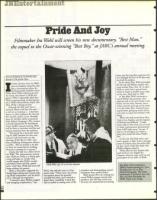
Philly Wohl, age 70, at his bar mitzvah.
Wohl, who tells the story in a first-
person style. "There were a lot of mis-
conceptions about the mentally
retarded back then, and I wanted to
dispel them. Gratefully, I think Best
Boy succeeded in erasing some of the
prejudices and distinguishing mental
retardation from mental illness."
Wohl started off to do nothing but
record Philly's progress toward inde-
pendence. But Best Boy turned into
the story of a much-loved son leaving