

Close Up
tional programs and an effort to build
a hospice for the region. But the
biggest programs aim to spur coopera-
tion and economic development.
Avi Assayag, head of economic
development for the city of Migdal
Ha'Emek, praises Partnership 2000
initiatives for uniting the region's cities
and towns toward common goals-.
"Before, each of the municipalities
used to fight each other, but now
they're doing things together," Assayag
says. "Partnership 2000 created a kind
of roundtable for us to sit at. For
instance, we're building an industrial
zone in conjunction with Emek Jezreel
that's going to be nearly 400 acres in
size, which is gigantic for this region."
Sixty percent of the Partnership
2000 budget for the region goes
toward economic development, says
Edna Rodrig, deputy mayor of
Nazareth Illit, another of the region's
cities. Rodrig estimates that by provid-
ing small business counselors to work
with would-be entrepreneurs, the pro-
gram has created thousands of jobs.
Rodrig speculates that more than
2,500 people —_new immigrants as
-well as residents of the region's kib-
butzim and moshavim — have
received help in setting up small busi-
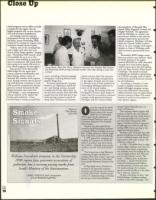
Danny Bitan, Albert Ben Brian, Federation Executive Vice President Bob Aronson
and Partnership 2000 steering commit -tee member Peter Alter during a recent visit
to Israel.
nesses, including a Russian-language
newspaper, a catering business and a
graphic design firm.
Economic development ventures,
however, are "fighting an uphill bat-
tle," says Rodrig, noting a national
recession has hit the region hard. In
the last three months, more than 900
people have lost their jobs due to fac-
tories moving overseas in search of
cheap labor. Dorfman and Aronson
express concern about the economic
downturn and rising unemployment
in the region; Aronson says he hopes
to alleviate some of these problems by
encouraging Michigan businesses to
invest in the Central Galilee.
Last spring, Partnership 2000 sent
Michigan's Governor John Engler to
Israel, where he unveiled an extensive
strategic trade agreement between
Michigan and the Central Galilee
ne of the reasons the Jewish
Federation of Metropolitan
Detroit selected the central
Galilee for its Partnership
2000 region was the presence of
Detroit-owned Phoenicia Glass, says
Federation Executive Vice-President
Bob Aronson.
However, the plate glass factory
owned by local businessman and phil-
anthropist William Davidson does not
have a stellar reputation with its nei
bors. It has been accused of polluting.
A 1996 grassroots campaign per-
suading the company to install $4-
million scrubbers may have solved
the problem, although some nearby
residents are still critical of Phoeni-
cia.
"The bottom line is that Phoenicia
is behaving all right, but there are
problems from time to time," says Gidi
Bressler, deputy director of the Israel
Environment Ministry's Northern Dis-
trict.
As Phoenicia's owner, Davidson is
involved in all important company
decisions, says Phoenicia's top executive
in Israel, Oded Tyrah. Until he accept-
ed the U.S. ambassadorship to Norway
late last year, businessman/philan-
,
William Davidson's company in the Partnership
2000 region faces grassroots accusations of
pollution, but is earning passing marks from
Israel's Ministry of the Environment.
LARRY DERFNER Israel Correspondent
JULIE WIENER Staff-Writer
municipalities of Nazareth Illit,
Jezreel Valley Regional Council and
Migdal HaEmek. The agreement
calls for Michigan to conduct two
searches per month in the state for
strategic opportunity partners for
Israeli companies. Michigan will also
allow the Central Galilee to adver-
tise, at no cost, strategic trade oppor-
tunities in State of Michigan trade
and investment promotional litera-
ture.
•
Partnership 2000's budget comes
from two sources, says Aronson. Qual-
ity of life projects in the region
received $850,000 in 1998, channeled
through the United Jewish Appeal,
which receives more than $13 million
each year from Detroit's Allied Jewish
Campaign. The people-to-people
exchanges are backed by approximate-
ly $750,000 annually, most of which
comes from special donations solicited
by the Federation.
According to Aronson, it is the
people-to-people component that
makes Michigan's program unique
from other federations' Partnership
2000 initiatives, most of which simply
funnel a portion of their UJA contri-
butions to social services projects in
their partner regions.
thropist David Hermelin was a co-
owner of Phoenicia.
The company, which employs 360
workers, moved to the new Na 7n reth
Illit industrial zone from Haifa about 4
1/2 years ago, before the area became
part of Detroit's Partnership 2000
region. Davidson said he is supportive
of, although not involved with, Part-
nership 2000. He set up shop in the
region for business reasons.
Davidson told. The Jewish News alle-
gations of pollution involving Phoeni-
cia are "a political matter with the vil-
lages and are well under control." He
declined to elaborate.
In 1996, 170 families from a neigh-
boring village, Hoshaya, and other sur-
rounding towns began complaining
the industrial zone was fouling the air,
and the highly sulfuric fuel Phoenicia
was burning created a stench. The
locals — religious Jews, secular Jews
and Arabs — joined with the Israel
Union for Environmental Defense,
and after protests, lawsuits and exten-
sive media coverage, the company
agreed to install scrubbers in the chim-
ney to clean up emissions.
"At first, everything was fine," said
Michal Barkan, a Hoshaya resident
involved in the 1996 campaign. "But