

•
••••••••••••••••••••
•
•
• •
:Club
Night
•
••••••••••••••••••••• •
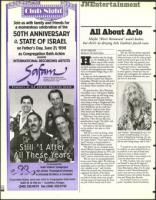
Join us with family and friends for
a momentous celebration of the
50TH AN
HE STATE OF ISRAEL
on Father's Day, June 21, 1998
as Congregation Beth Achim
presents
INTERNATIONAL. RECORDING ARTISTS
A portion of the proceeds will be
donated to NOAM, the Conservative
Youth Movement in Israel
Co- ponsor
Adat Shalom Synagogue
A the Jewish Theological Seminary
& Schostak Brothers & Company
To purchase tickets, send your check to Congregation Beth Achim
21100 W. 12 Mile Rd. • Southfield, Michigan
6/12
1998
88
(248) 352-8670 Fax (248) 352-5752
JNEntertainment
All About Arlo
Maybe 'Alice's Restaurant" wasn't kosher,
but there's no denying Arlo Guthrie's Jewish roots.
ALAN ABRAMS
Special to The Jewish News
El
is mother was the daugh-
ter of a Yiddish poet. His
father was an Okie trouba-
dour. And from that mix
emerged musician and storyteller Arlo
Guthrie, who brings his own unique
voice to Ferndale's Magic Bag on Fri-
day, June 19. ,
As the son of the legendary bal-
ladeer Woody Guthrie and Marjorie
Greenblatt, Woody's second wife and a
Martha Graham dancer, Arlo grew up
in a family where creativity was the
norm.
His grandmother, Aliza Waitzman
Greenblatt, was a well-known Yiddish
poet whose songs are still being sung.
"Just the other day, one of the
klezmer bands and Yitzhak Perlman
were doing a thing at Tanglewood (the
performing arts center in Massachu-
setts' Berkshires) up the road here,"
said Guthrie, "and my sister Nora
(who directs the Woody Guthrie
Archives in New York) was there.
'Afterward, they came up and
asked her, 'How did you like your
grandmother's songs?' She didn't real-
ize they had played [them]."
How great a role did the Judaism
on his mother's side play in Arlo's
upbringing?
"My life as a kid was being a little
Jewish kid. I went to the typical sort
of Jewish kid camps," said Guthrie,
50, whose father's "This Land Is Your
Land" became a virtual anthem at
Workmen's Circle children's centers.
"My father was in a hospital some-
where (Woody Guthrie was diagnosed
with Huntington's disease in 1951 and
died from the debilitating illness in
1967), and we visited him every week.
"But we went to my grandmother's
house every Friday night. We didn't go
to temple, but we had our own sort of
spirituality, and in real life it's [been]
very valuable to me," said Guthrie,
whose bar mitzvah was a hootenanny
organized by friends of his father.
"On both sides of my mother's and
my father's family, there were people
writing songs and expressing the deep-
est part of their hearts and of their
own spirituality.
"For me, that has always expressed
itself [not in ritual observance] but in
what you've got to do for other people
[and] in what you've got to do for the
world. That's why [my parents] were
so involved in the conditions of work-
ing men and women," said Guthrie.
"They felt it was their responsibility
to react against a world that was not
always easy, and against the traditional
kinds of spiritual dilemmas that peo-
ple have to deal with.
Ark Guthrie: "Spirituality for me is not
a matter of understanding. It is not a
matter of deciphering meaning. For me,
it is an act of service — to myself and to
all the other living things, and to God"
"It could be on the corporate level,
it could be on some political level, or
it could be in the case of Israel now,
where you have a whole country
divided over what it even means to be
a Jew, let alone how to be one."
In 1992, Guthrie, who now consid-
ers himself "a man of all religions,"
purchased the old Trinity Church in
Great Barrington, Mass. It's the place
where he wrote "Alice's Restaurant,"
and it now serves as a home for the
Guthrie Center, the Guthrie Founda-
tion and Rising Son Records.
The Guthrie Center is a not-for-
profit "interfaith church foundation
imo