

Photo cou rtesy of the Burto n Historical Collect ion of the Detroit Pu blic Library
manager for "The Bill Kennedy
Show," which showcased classic films.
In 1978, Glaser moved to Los
Angeles and was hired by Golden
West Broadcasters, then owned by
Gene Autry. He worked as a stage
manager or prop master on dozens of
network and syndicated shows includ-
ing "WKRP in Cincinnati" and
"Jeopardy."
In 1987, he won an Emmy for his
documentary "Justiceville," which is
about the homeless. In 1991, his
"Bombing L.A." took a controversial
look at graffiti culture and won a
Bronze Apple at the National
Educational Film Festival.
Glaser returned home in 1993 and
produced a number of projects for
WTVS. He won an Emmy for his
documentary "Borderline: The Story
of Eight Mile Road."
The filmmaker, who attended
Henry Ford High School and Temple
Beth El, retains his interest in the city
and shows his documentary to
requesting groups. He finds it interest-
ing that the building with America's
largest flag will be featured on televi-
sion during Flag Day.
"The video brings groups together
for discussion, and pretty soon, the
mood seems like a town hall meeting,",
said Glaser, whose production compa-
ny is Urban Garlic. "I don't consider
myself an activist; I consider myself a
filmmaker."
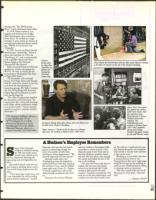
Historic
photo taken
on Flag Day.
Hudson's was
famous for
displaying
America's
largest flag.
Gary azzer, the documentary's director, films artist Maurice Greenia -
as he draws his murals on the side of the Hudson's Building.
❑
"The Hudson's Building" will air at
7 p.m. Sunday, June 14, on
WTVS-Channel 56. It will be
shown on a big screen at 1 p.m.
Saturday, June 13, at the Detroit
Historical Museum, where it is
screened monthly. (313) 833-1805.
Developer Randy Alexander, above, joins the debate over
the fate of the Hudson's Building.
Right: Namon J. Clarke recalls his days as an elevator
supervisor. He worked at Hudson's from 1949-1979.
Above: Dave Toorongian,
left operates the camera
while Gag Glaz.er, mid-
dle, interviews Jessie
Schneidewinch a former
Hudson's food service
employee. Mrs
Schneidewinch who
worked at Hudson's from
1931-1942, prepareth
among other things,
Hudson's legendary chicken
pot pie and Maurice salad
A Hudson's Employee Remembers
S baron Uten Zamczyk
worked at Hudson's during
the '60s and recalls many
special times related to her
job as a copywriter planning the
signs going into the legendary win-
dows.
She worked closely with the win-
dow dressers, thinking about scenes
that would bring shoppers into the
store.
"There were three copywriters, and
I was responsible for men's clothing
and household appliances," recalled
Zamczyk, who was the only Jewish
person in advertising, though she
knew of a number of other Jews
working in various departments. "We
felt very important and very special."
Zamczyk awoke early every
Thanksgiving, when she helped the
Parade performers with their costumes.
She arrived at 5 a.m., and the hubbub
began right away. Owner J.L. Hudson
Jr. always stopped by to take a look
and personally compliment the work-
ers.
Zamczyk, who lived in Windsor
and now resides in Farmington Hills,
remembers a winter storm in 1965,
when she made it into work only to
find that Hudson's would be closed
that day. She had taken a bus through
the tunnel and walked the rest of the
way to the building.
"The man who was at the door to
explain that the store was closed
noticed my boots and said I really
needed a taller pair for the bad
weather," Zamczyk remembered. "He
took me to the shoe department, and
I picked out some that would be bet-
ter. He told me I could pay the next
day. Besides being the rare employee
who arrived, I was the only customer
in that entire store."
Working at a time before electron-
ic security devices were in use,
Zamczyk knew that every night dogs
would be brought in the building to
sniff out any would-be thieves hiding
in dressing rooms or restrooms.
"We were treated well, and we all
felt proud to work there," Zamczyk
said.
— Suzanne Chessler
6/12
1998
87