

JNEntertainment
SUZANNE CHESSLER
Special to The Jewish News
Mr
hat draws a crowd of
more than 40,000, fea-
tures stellar music mak-
ers such as Debbie
Friedman and Peter Himmelman,
showcases artwork from around the
world and is strictly kosher?
The Greater Chicago Jewish Folk
Arts Festival.
The daylong event — scheduled
Sunday, June 14 — only asks a $2
donation for admission, a minimal
materials fee for the hands-on art
activities and individual costs for food
and souvenirs. Everything else is free.
For those who can't afford a dona-
tion, admission is free, too.
"We want everything to be high
quality," said Michael Lorge, founder
and chairman of the all-volunteer
Jewish Production Organization for
Cultural Events and Theatre
(P.O.C.E.T.), the festival sponsor.
"We create a total environment
that connects people to Judaism. It
seems that Jewish people now are
struggling to build a sense of commu-
nity and continuity, and I think both
come naturally w en Jewish life is
celebrato
esides the headliners, the festival
draws on many entertainers whose
work is based in Chicago. For exam-
ple, Kol Sasson, who brought singing
and instrumental talents to the
Jimmy Prentis Morris Jewish
Community Center earlier this year,
will be on stage along with klezrr —
bands, Israeli dancers, marionett
and singing groups.
Two sound stages hold non-
stop music makers.
Artists with fresh expressions
of Judaica will show and sell
their works. Mary Etta Moore of
Kalamazoo, who works in cut
paper, will be among many arti-
sans traveling to Chicago.
"I've been showing my work
at the festival since 1986," said
Moore, who will be one of the
people discussed in a soon-to-
be-published book, Jewish Artists
Today.
Moore does repetitive series,
many depicting cycle-of-life
events, and will customize piece.
to fit in with the color schemes
of specific decors. A recent pro-
ject is a 13-piece combination
depicting the Jewish holidays.
Besides mounting her cut paper to
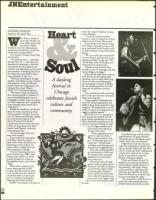
A daylong
festival in
Chicago
celebrates Jewish
culture and
community.
create the sense of shadows, she also
uses calligraphy.
"I try to do work for families
because I think it's important to have
Judaica in the home," Moore said.
Jewish authors will attend to sign
their books, and kosher caterers will
serve traditional Jewish foods as well
as dishes popular among other ethnic
groups.
"We try to add a new component
to every festival, and this year, we are
adding genealogy," Lorge said. "We
will set aside a tent for lectures, pre-
sentations and computer use. •
"Hands-on arts activities were
started as a test 10 years ago, and they
just got bigger and bigger."
Lorge and his wife, Susie, came up
with the idea for the festival after
spending a year in Israel. Returning
home at a time a neo-Nazi group
was attempting to march in Skokie,
Ill., the couple wanted to do some,
thing that would have a positive
effect.
They noticed that little was being
done in the arts and were concerned
about correcting that.
- "I knew people in leadership posi-
tions with various organizations and
talked to them about a festival," Lorge
explained. "We decided that to be suc-
cessful, we had to be autonomous and
suggest no political agenda"
While P.O.C.E.T. is nonpolitical;
there is space for political and reli-
gious Jewish organizations to set up
tables, distribute pamphlets and dis-
cuss their activities. Ninety-six orga-
-""ns, the largest number since
tival started, have signed up
for this year's event.
"These organizations have
agreed to mail out festival
fliers to their members, and
mut 100,000 have gone out,"
Lorge said. "We also make
yard signs, and those go up in
many Jewish neighborhoods."
More than 6,000 attended
the first festival in 1980, and
the numbers have increased
steadily for the event held
every other year.
Financing comes through
grants, corporate gifts, private
donations and sales of ad space
in the festival program book.
Corporate gifts. and grants
from individuals and founda-
tions underwrite specific corn-
onents such as the stages, food
tair, art fair and hands-on activi-
ties area.
Contributions go toward produc-
ing the festival. No group benefits
financially and no individual receives
a salary from these contributions.
Lorge knows of at least one mar-
riage that resulted from people meet-
ing at a festival. Before the next festi-
val, the couple had their wedding and
continued to celebrate by inviting
guests to join them at what has
become a Chicago tradition.
"There are between 30 and 50
people on our steering committee,
each bringing a special expertise to
the planning," said Lorge, whose
entire committee, with some 200
members, gets together the Friday
before the festival to set up the tents
and get everything else ready.
The committee would like to net-
work with other groups planning
Jewish festivals around the country