

C011111111ITY VIEWS
Seeing More:
The Ties That Bind
jr
RANIA SABA AND
JENNY STRAUS Z
Special to The Jewish News
envy and I each have friends
and relatives living in the Mid-
dle East. One of Jenny's best
friends, Chen, lives in Timrat,
Israel. I have seen pictures of Chen,
read some of her letters and even lis-
tened to a tape that she made for
Jenny's birthday last year. I feel like I
know the girl.
Jenny has also seen lots of pictures
and heard lots of stories about my aunt
Rima, who is also over there. It is diffi-
cult for us to picture our loved ones not
getting along with each other. We know
that if they could put aside their differ-
ences, they would get to know and
understand each other and get along
quite well. Instead, they are blinded by
prejudice, violence and evil; and they
do not live in peace.
It has been said that evil stems from
not seeing enough. So perhaps to become
less evil we need only to see more. For
Rania and me, this activity has provided -
that much-needed vision. It has shown us
that we come from two distinctly different
cultural backgrounds. It has shown us that
Rania Saba is a Plymouth-Canton
High School senior. Jenny Strausz is a
senior at Birmingham Groves. This is
the conclusion of their essay, which took
first place in the American Arab & Jew-
ish Friends' 1998 Duane Kell Memorial
Scholarship competition.
we have differing opinions on certain
issues. It has shown us that we've had dif-
ferent life experiences and that we worship
in different ways.
Most importantly it has shown us that
none of those differences matter. We have
learned that our similarities outweigh our
differences and that our differences make
our friendship a more interesting one.
We have also realized that even our
differences are not quite so different
when closely examined. I experienced
Jenny's culture through having dinner
with her family, seeing a Jewish play
with her and visiting the Jewish Com-
munity Center. I also learned a lot
about Jewish culture through Jenny and
her family.
Jenny experienced my culture
through a Sunday dinner with my fami-
ly and coming to school with me. She
learned even more about my culture
through discussions with me and my
family-. We often joke that she is now an
expert in Arab culture and I could teach
classes in Judaism.
The similarities between our cultures
are endless. We keep finding more and
more things that we have in common.
Our families are quite similar. Since both
of our cultures are very family oriented,
we each spend a lot of time with our par-
ents and respect the rules that they set for
us (which, by the way are also similar).
Many of our values and beliefs also
connect. Family, religion and education
are very important to both of us.
Although Jenny and I are of two differ-
ent religious backgrounds, we are very
much alike.
Some of the Jewish prayers and life-
cycle events are quite similar to those of
my religion. We both participate in reli-
gious activities — she with her temple
and I with my church.
Our educational goals
are also similar. We
both believe in work-
ing hard and will con-
tinue with a college
education next year.
She is one of the most unique and
interesting people I know. Just ask my
friends. Ever since I met Jenny, they
have been hearing about her constant-
ly. She is creative and intelligent and
sincere. She can find humor in almost
anything, and she is also a great listen-
er who made me
feel comfortable
from the start. She
is the type of person
who always has a
song in her head.
She is the type who
will try on every
piece of clothing at
the mall and not
buy anything.
The first day I met
Rania, I saw a girl with
glasses, olive skin and
long brown hair pulled
back into a ponytail.
Rania and I
Now, I look at her and
clicked instantly.
see one of my closest
Within 10 minutes
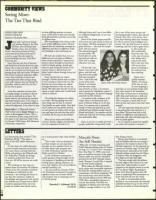
Rania Saba and Jenny Strausz
friends. I see someone
of the time we met,
with the same wac
we were laughing so
sense of humor as mine. I see someone
hard that we were getting strange looks
with a passion for Catholicism, striped T-
from other people in the restaurant.
shirts, chewing gum, the Spanish language
Since then, we have met in restaurants,
and books by John Grisham.
coffee shops and malls just to talk and
I see someone with a sculpture of the
shop. Each time, we have enjoyed each
Virgin Mary in her front yard and a
other's company so much that we lose
poster of Antonio Sobato Jr. in her bed-
track of time and return home later than
room. I see someone who is responsible
expected.
enough to hold ajob and keep up with
The most important thing that each of
schoolwork and still find enough time for
us has gained from this experience is a
friends and family I see someone who has
new friend We have been able to look
earned my respect for her hones t y enthusi-
beyond our differences and understand
asm and creative ideas.
and accept each other and truly enjoy the
time we spend together.
Jenny is not just a smiley girl with a
As we continue to spend time together,
purple, polka-dot composition book.
our vision will continue to increase. ❑
LETTERS
er's fascinating class entitled "The
Rabbinic Mind." This class is
part of the AJE Adult Education
series.
In this class, the rabbi discusses
various Jewish practices and events.
He traces them, starting with the
Bible and going to the Talmud and
the Rishonim. Finally, he brings
in modern authorities from our
own era. All of his sources are tradi-
tional.
The students in this class are
drawn from all branches of Judaism.
Those of us who consider ourselves
Orthodox are definitely in the
minority. I am writing this letter to
say that the reverence, depth of
knowledge and openness with which
my Reform and Conservative fellow
students approach these texts has
made me realize that which unites
us is much greater than what divides
us.
This is why I was so shocked to
see that temples in our area have
brought in two speakers from out
of town whose sole purpose was
to vilify Orthodoxy, namely Leah
Rabin and Ze'ev Chafets.
In the Orthodox community, I
recall speakers being brought in for
the purpose of speaking on the fol-
lowing topics: gossip, penance, sci-
ence and religion, love of our fellows,
marital harmony, etc.
I do not recall an instance where
the Orthodox community brought in
speakers from out of town whose
sole purpose was to disparage anoth-
er Jewish group.
Herschel L. Schlussel, M.D.
Southfield
Maccabi Hosts
Are Still Needed
With only 12 weeks remaining until
2,800 Maccabi athletes arrive in Detroit
on Aug. 16, "Crunch Time" certainly is
here. Your May 15, 1998, cover story
gave an excellent overview of the prepa-
rations under way and the scheduled
activities for the JCC Maccabi Games
week. However, I would like to expand
on the host family program.
What makes the Maccabi Games a
truly unique and memorable experience
for both the visiting athletes and our
community is the home hospitality. We
have heard many times from families
that housed athletes in both 1984 and
1990 what a wonderful experience it
was for their family. This held true
regardless of whether they had small
children, teenage children, or no chil-
dren living at home.
Being a host family is a wonderful
way for children who are too young to
compete in the Games to share in the
Maccabi experience. At the opening cer-
emonies on Sunday, Aug. 16, they will
feel excitement and pride as the 3,400
Maccabi athletes march into the Palace
of Auburn Hills, by delegation, with
their flags and heads held high.
They can mingle with the athletes
the next night at the Detroit Zoo and
watch their "older brother or sister"
compete at the daytime events or at the
JCC on Sports Night. By getting to
know their Maccabi guests, they will
come to understand the connection we
share with Jews all over the world.
In order to accommodate all the
families in our community, the Maccabi
schedule has been set up so that even if
there are no adults at home during the