
SUZANNE CHESSLER
Special to The Jewish News
he Michigan Opera Theatre
(MOT) won't serve a cake
with candles to celebrate the
100th anniversary of com-
poser George Gershwin's birth, but it
will have what could be the realization
of a birthday wish — an acclaimed
production of Porgy and Bess.
The folk opera — an American
classic about triumphant faith and
love in the slums of Charleston, South
Carolina — runs May 30-June 14 at
the Detroit Opera House and stars
Gordon Hawkins as Porgy, Marquita
Lister as Bess and Peabo Bryson as
Sportin' Life.
While the show has undergone
changes since its introduction in
1935, the songs remain true to the
spirit infused by George Gershwin's
music and Ira Gershwin's and DuBose
Heyward's lyrics in numbers such as
"Summertime," "I Got Plenty 0'
Nuttin," "Bess, You Is My Woman
Now" and "It Ain't Necessarily So."
Since its premiere and subsequent
travels to international stages, Porgy
and Bess has met with some controver-
sy among black Americans concerned
that the production casts blacks in a
negative light.
Taking issue with those views are
two Gershwin scholars, both with ties
to Michigan — Deena Rosenberg,
who is Jewish, and Dr. James
Standifer, who is black.
Rosenberg, author of Fascinating
Rhythm: The Collaboration of George
and Ira Gershwin and founding chair
of the Graduate Musical Theatre
Writing Program at New York
University, expresses her beliefs
through her book, published by the
University of Michigan (U-M) Press.
Standifer, creator of the Public
Broadcasting System documentary
"Porgy and Bess — An American
Voice" and professor of music at U-M,
shares many ideas in the program now
available on videotape.
"I think that both George and Ira
felt that Porgy and Bess was their major
work," said Rosenberg, who inter-
viewed Ira as part of her research.
"They were very disappointed that
it didn't get the [early] reception that
they hoped it would, not just from the
African-American community but in
general. It took a few years before it
caught on because people didn't know
what to make of it. Was it an opera?
Was it a musical?
5/22
1998
92
The Michigan Opera Theatre
presents the Gershwins'
operatic masterpiece.
"George never lived to see Porgy
and Bess [reach] the point where it's
considered America's major opera, but
Ira got to see all of that and found it
gratifying in the decades after George
died [at age 38]."
Rosenberg believes that the social
problems, such as racism and poverty,
depicted in the opera should be con-
sidered in a larger context than the —\
black neighborhood being portrayed
through the production.
Based on the play by DuBose and
Dorothy Heyward, who adapted it
from his novel Porgy, the story line
was taken from a newspaper article
read by DuBose Heyward.
"I think that the piece is talking
about the large forces that can grind
people down," Rosenberg explained.
"The social problems are still with us
in urban contexts, not just among
African Americans.
"In New York, we have Chinese
American sweat shops that are being
uncovered that nobody knew existed
and are as bad as anything known
about in terms of almost slave labor.
"The positive message is that [these -_- \'
conditions] don't have to grind people
down. It shows the values that have to
do with hope and breaking the cycle
of problems associated with poverty."
As the opera was being developed
and performed on many stages,
changes were made to make the work
more acceptable to its detractors, par-
ticularly actors and actresses. Harry
Belafonte refused the movie role of
Porgy, for example.
Offensive terms were removed from
the dialogue, and the character of
Porgy was dignified by having him
walk with crutches instead of moving
about on his knees.
Standifer will explore these issues
with a MOT symposium panel of per-
formers and scholars scheduled for 7-9 _
p.m. Thursday, May 28.
"The opera opens a window into
American culture and the African-
American experience," said Standifer,
whose interest in the work began
when he was a child watching a per-
formance and carried over into his
own college studies at Fisk University,
where he was a Jubilee Singer.
'
--/
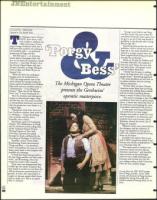
A scene from the 1987 MOT produc-
tion of Porgy and Bess. In the 1998
version, the character of Porgy has been
dignified by having him walk with
crutches instead of moving about on his
knees.
Scanned image of the page. Keyboard directions: use + to zoom in, - to zoom out, arrow keys to pan inside the viewer.
May 22, 1998 - Image 160
- Resource type:
- Text
- Publication:
- The Detroit Jewish News, 1998-05-22
Disclaimer: Computer generated plain text may have errors. Read more about this.