

I
Front
r ■■ •
kamittrANAO
YAD EZRA
fffditg #teTe 4 k Hwy
The Board of Directors
and Staff of
Teacher Sues Akiva
Yad Ezra
Hebrew day school denies allegations
of age discrimination and breach of contract.
wish to thank
Paul Kohn
and the staff of
Quality Kosher
Catering
for hosting
`A Taste of Quality'
Thank you for choosing
Yad Ezra
as a recipient of
this successful effort.
.
ICA% NASS, USA
GARFIELD & MARKS
zanella JOAN 6DAVD
HANDBAGS & BELTS
Cyd Samm
& Mare!
INSIDE
ORCHARD MALL
West Bloomfield
Orchard Lake Rd.
North of Maple
248-626-0886
5/22
1998
10
Check out the
Painters and
Wallpaper Hange
in our Marketpl,
Home and
Service Guide
JULIE WIENER
Staff Writer
la
dward Codish, a teacher for
10 years at Akiva Hebrew
Day School, is suing the
Orthodox school, alleging
age discrimination and breach of con-
tract. He and his wife, Susann, also an
Akiva teacher, are quitting at the end
of the academic year and have accept-
ed teaching positions at Boston's New
Community Jewish High
School.
Akiva's attorney, Steven
Z. Cohen, denies the alle-
gations laid out in the
lawsuit.
A teacher of high-
school English and Judaic
studies who received
tenure in 1993 and was
— according to forms
Akiva submitted to the
Internal Revenue Service
— once the school's third
highest-paid employee,
57-year-old Codish filed
suit last fall after Akiva
cut his hours and salary in
half and assigned his
Judaic studies classes to
Rabbi Daniel Arm.
In his suit, Codish alleged that
Principal Rabbi Karmi Gross informed
him last spring he probably would not
be working at the school in 1997-98
because Gross had "philosophical dif-
ferences" with Codish and believed
him "too old to change." According to
the complaint, when Codish informed
Gross he was tenured and could not
be summarily discharged, Gross told
him "new tenure provisions were
being imposed allowing for plaintiff's
discharge."
Gross, who has been with Akiva
since 1995, declined to be inter-
viewed.
Cohen, Akiva's attorney, denied
that Gross made the comment about
Codish's age. According to Cohen, the
fact that Codish was retained half-
time indicates he was not dismissed
and thus the school did not violate
any tenure agreements.
"The tenure clause under Akiva's
manual is a severance provision, not a
guarantee of employment," Cohen
said. "Should we ask [Codish] to leave
and eliminate his employment com-
pletely, we'd have to pay him certain
severance, but we didn't. We had no
intention of firing him."
Peter Dodge, Codish's attorney, dis-
agreed: "For all intents and purposes,
[Codish] lost his job. He can't main-
tain his household on half-time work
and the school knew that."
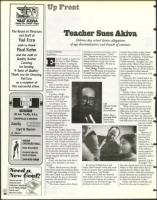
Ltft:
Edward Codish:
Claims age
discrimination.
Below: Akiva
principal Rabbi
Karmi Gross
with students.
By cutting Codish's hours and
salary, Akiva created "terms and condi-
tions so onerous that a reasonable per-
son would leave," said Dodge.
Cohen said Codish was removed
from Judaic studies for "economic and
non-economic reasons, but under no
circumstance on the basis of age." He
declined comment on Codish's
removal from Judaic studies classes
and the "philosophical differences"
noted in the complaint. A brief filed
by Akiva in October alleged that
Codish showed a "disregard" for "pro-
prieties of the Hebrew Day School —
that he had begun having discussions
in classes that were out of the realm of
what a parochial school deemed
appropriate for open discussion with c_,
its students. —1
"Moreover, Mr. Codish had to be
reminded that he was to abide by the
curriculum and not foray into texts
that were objectionable from a reli-
gious point of view," the Akiva brief
alleged.
Neither Cohen, Codish nor Dodge
would elaborate on the texts or discus-
sions in question. But according to
Dodge, the school did not raise such
concerns until after its "constructive
discharge" of Codish.
"What they're saying now is that
they're doing this because they had
difficulties with him," said Dodge.
"But Rabbi Gross never requested a
curriculum plan from my client and
admitted that under oath. Had he had
real difficulties with my client's teach-
ing, you would
have expected a
curriculum
request."
However, in
its 1993 letter
granting him
tenure, Akiva
stipulated to
Codish that if he
used texts outside
of the adminis-
tration-approved
curriculum, he
needed to submit
them for
approval. The let-
ter added: "We
have also placed upon you the respon-
sibility to select those items that are c —\
appropriate for Hebrew day school
students to learn. Materials containing
sexual references can certainly not be
altogether avoided, but should never
be topics for discussion in class."
Cohen said Akiva would have pre-
ferred that the case be argued in a