

Father Of
The Modern
Comic
Will Eisner is a giant in
the field of sequential art.
HANK BORDOWITZ
Special to The Jewish News
omic books are the Rodney
Dangerfield of American lit-
erature. They pull at their tie
and complain about not get-
ting respect, yet continue to clown
around about it.
So, when I ran into an older
woman who used to live in my old
neighborhood in the Bronx at a party
not long ago, I recommended a won-
derful book called Dropsie Avenue. The
story chronicled what went on in the
old neighborhood with an alarmingly
accurate eye.
I felt compelled to warn her, how-
ever, that the book was a graphic
novel. When she did not under-
stand the term, I sighed and told
her it meant a book told in panel
graphics, kind of like a comic
book of novel length.
While essentially true, this
description would make Will
Eisner sigh, too. The author of
Dropsie Avenue (1995) and a
dozen or so other graphic novels
and books, Eisner fights a never-
ending battle worthy of
Superman.
Along with people like Harvey
Pekar, Frank Miller, Pulitzer
Laureate Art Speigleman, Joe
Kubert and numerous others,
Eisner has been trying to earn a
little respect, if not for his work at
least for his medium.
"In 1974, I began my first
graphic novel, A Contract With
God," Eisner explains. "I dealt
with a very unusual subject for
comics. I knew this was_ of no
interest to the young reader, but I real-
ly was trying to break new ground.
"I completed the thing in tight
dummy form. I called up the head of
the largest publishing company in
New York, whom I knew and who
knew my work.
"I said, 'Look, I have something
very interesting here for you. I'd like
C
7)
Hank Bordowitz is a New York-based
freelance writer.
to bring it up to show it to
you.' He said, 'Well, per-
haps you'd better describe
it to me first.' I looked at
it. I couldn't bring myself
to tell him it [was] a comic
book dealing with an adult
subject, so I told him, 'It's
a graphic novel.'
"I just invented the
word out of sheer despera-
tion. He said, 'That
sounds interesting. Bring it
up here. I'd love to see it.
We've never seen anything
like that.'
"I brought it up and
showed it to him, and he
said, 'Well, it's a comic
book. I don't think we can
publish it."'
Nevertheless, changes
have worked their way into
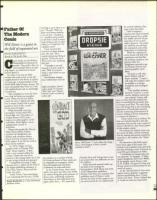
Right and below: Eisner's
comic novels 'A Contract
With God" and "Dropsie
Avenue" center on slices of
urban lift.
NENT
Above: Will Eisner: "I write about the things I
know, which happen to have a Jewish
neshama to them."
the medium on a number of levels.
In Europe and parts of Asia, comics are
as respectable as newspapers. Adults
from all backgrounds read them,
unashamed, on trains and buses.
In the United States, where many
adults who grew up with comic books
are rediscovering this guilty pleasure of
their youth, publishing companies
have begun to deal with these born-
again comic fans — DC started the
Paradox Press and Vertigo lines to put
out comics that very definitely are not
for children.
Adult-oriented material makes up
the bulk of the catalogs for
Fantagraphics, Dark Horse and many
of the independent publishers.
Kitchen Sink Press, the company that
publishes much of Eisner's work,
devotes the bulk of their paper to sto-
ries and artwork far too sophisticated
for anyone without a few
years under their belts.
These companies,
imprints and adult-oriented
comics account for a small
but sizable (around 25 per-
cent) slice of the comics
sold in America. The medi-
um itself has moved from
the newsstands and comic
book shops to bookstores.
While the majority of
comic books still deal with
superheroes and the like,
the medium reached a new
plateau when Art
Speigleman received a spe-
cial Pulitzer Prize for his
amazing graphic novel
Maus.
"It's hard to tell what
Artie's Pulitzer will do,"
Eisner remarks. "I hope it
will make the medium more
acceptable to a serious,
thoughtful and intelligent
public.
"One problem remains,
however: 'Comics' is a mis-
nomer. Modern comics are
not comical. Comics still
carry on their back the implication
that it's something for juveniles, that
it's literary junk food. The only thing
that will change that is the continuing
appearance of worthwhile material
and the continuing achievements of
creators willing to devote themselves
to content of substance."
Eisner tends toward modesty. He
does not include himself in this last
statement, but any fan with a sense of
history will tell you that Eisner parent-
ed the modern comic.
The industry he helped create over
the course of half a century honored
him by naming the annual awards for
creativity in the medium the "Eisner
Award."
His devotion to the field comes
from twin urges of his youth. He
wanted to be a painter and toyed with
the idea of being a writer. However, he
never felt quite adequate at either.
"I combined two ineptitudes into
one eptitude," he laughed. If Maus
makes Speigleman the Orson Welles
of the graphic novel, Eisner is the
D.W. Griffith. He spent his long and
diverse career as a frontiersman in the
world of comics.
In the '30s the funnies from news-
papers were so popular, magazines
started republishing them. Comic
books were born. Eisner realized that
it would not take too long before