

-10111111111111111XIINNINIMPIIIN,
UMW
a
stay. He remembers the Rosh
Hashanah address Schwartz gave, after
which a majority of the congregants
stood silently in support of the rabbi,
in defiance of the board.
"It was a very moving moment,"
Levine said. "It was totally impromp-
tu.
The chavurah, which Levine and a
handful of others started, began to
take on new meaning as members
grew less attached to the temple and
more amenable to the informal reli-
gious/friendship circle; it allowed
them to continue their formal connec-
tion to Judaism and each other.
Mary Sue Munter, a member of the
early chavurah, said participants knew
they didn't want to be a part of Beth
El, but they weren't certain of what
the future would hold.
"We kind of hoped that we could
form a congregation, but we didn't
know what it would take to do that,"
she said.
5/8
1998
86
In the meantime, the group met in
ceremony. Her husband, Alan, asked
each other's homes, often beginning
the rabbi what it would take to start a
services as the aromas of chicken soup
congregation.-
and brisket filled the air. Munter
"And the rabbi said, 'Give me 100
remembers the time she stayed up the . families and we'll see what we can
night before hosting 40 chavurah
do,"' Mindlin said.
members for dinner and ser-
Schwartz remembers that
vices only to have her hot
time and several other occa-
Shir S haloms sions when other chavurah
water heater bottom out at 2
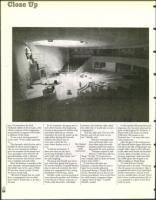
sanc tuary,
a.m.
members pulled him aside to
un der
"I told the serviceman, 'I
ask exactly the same question.
cons truction.
don't care what you do, but I
"Everyone wanted to talk
am having 40 people to dinner
about it. I told them talk was
and I need a hot water heater now,"'
cheap," he said. "It is expensive to
she said, laughing.
start a temple, both in terms of money
The group was friendly and inclu-
and in terms of life."
sive; word soon spread and it grew to
It was about this time that
30 member families. It rapidly became
Schwartz, a month before he was to
clear to chavurah members that their
begin his six-month sabbatical,
dream of a congregation had a strong
announced during a Temple Beth El
probability of becoming a reality.
family Chanukah service that he was
Mindlin recalls a pivotal meeting of leaving immediately. As he exited from
some chavurah members and Schwartz the small chapel, congregants began
at the House of Hunan restaurant on
singing "Rock of Ages," a capella,
Twelve Mile Road after a Havdalah
Mindlin recalled.
In the months following Schwartz's
departure, the chavurah continued to
grow, as did support for Schwartz. A
dinner held in his honor in March
1988 drew 500 people to the
Somerset Inn — so many that some
were turned away.
After the glow of the evening wore
off, chavurah leaders began discussions
that led to the idea of beginning a new
temple. Talks began to hire Schwartz
as the rabbi and a search was launched
to find a place of worship. Levine, an
attorney, negotiated a three-year deal
for 9,000 square feet of space in an
office building on Maple Road.
"It could not be a church,"
Schwartz said at the time. Theorizing
that the group was starting in what is
considered the thick of an established
Jewish community, a church would
not be a suitable place, he said. And it
had to have a more permanent feel to
it, as opposed to a space rented from
week to week.