

Wars
TEE WAR OF INDEPENDENCE
Background:
After occupying Palestine for 30 years, the British
decided to leave Palestine in 1947 due to the increas-
ing difficulty of ruling the warring Jewish and Arab
communities. A United Nations special session arranged a plan to divide
Palestine into two sections, one for a Jewish state, one for an Arab state;
Jerusalem would become an international zone under U.N. jurisdiction. The
Arabs protested violently, attacking Jewish settlements, while the British most-
ly refused to intervene, and arranged to leave on May 15.
Statehood:
On May 14, 1948, Jewish leaders excitedly proclaimed the establishment of
the State of Israel. By the next dawn, the united armies of Egypt, Transjordan,
Syria, Lebanon, and Iraq, together with Palestinian guerrillas, crossed the bor-
ders and attacked. But the numerically overwhelming Arab troops were turned
back, and the nascent country ended up with nearly double the land originally
allocated by the UN partition. In January 1949, the U.N. brokered separate
armistices between Israel and her four neighbors, maintaining the territorial
gains won in the war.
Aftermath:
Israel became a viable country, but not without a price. The majority of the
800,000 Palestinians who lived in Israeli-held territory became refugees, which
ended the Arab majority in the Jewish state, creating problems still not
addressed today. Meanwhile, as David Ben-Gurion was confirmed as Israel's
first prime minister, the Jewish guerrilla fighters led by Menachem Begin —
long at loggerheads with the established leaders — formed an opposition
party, and the state began absorbing more than one million Jewish immigrants
from Arab lands.
TEE SUEZ CRISIS
Background:
nGreat
Britain
and France, angry at Egypt's Gamal Abdel
•J3
Nasser for nationalizing the Suez Canal, strengthened
military ties to Israel. Flaring border incidents had
plagued Israel and its Arab neighbors, igniting growing hostility on both sides.
When Egypt blockaded the Strait of Tiran — Israel's sole access route to the Red
Sea — and refused to let Israeli ships through the Suez Canal, the Jewish state
struck back. France and Great Britain, sensing welcome opportunity and eager
for spoils, joined the Israelis.
The war:
Fighting started in October 1956. Israel quickly seized the Gaza Strip and the
Rx,
TEC SIC -pay WAR
Sinai Peninsula. French and British elite troops joined the Israeli forces in reach-
ing the canal. After a few days, the United Nations arranged a cease-fire and sent
an emergency force to patrol the canal zone. Both the United States, angry at
Israel for its border skirmishes, and the Soviet Union backed the United
Nations. By January 1957, the British and French had left, and Israel troops
went back to the 1948 armistice borders.
Aftermath:
The war marked one of the few occasions of U.S.-U.S.S.R. cooperation during
the Cold War, but did little to strengthen the relationship between the two
countries. Nasser, by standing up to the Europeans, increased his standing in the
Arab world. The usual uneasy peace settled back over the Middle East.
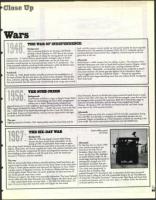
Israeli soldiers patrol
the border.
Background:
After the 1956 war, Egypt's Gamal Abdel Nasser
became the hero of pan-Arab nationalism. In the
spring of 1967, he persuaded Arab troops to again
mass along Israel's borders; reinforcements came from as far away as Iraq and
Algeria. Meanwhile, the Soviets supplied the Arabs with military hardware and
advisors. The Israelis, recognizing the threat and plagued by terrorism, had
been beefing up their military as well. By early June, with the Americans
focused on Vietnam, tensions exploded.
Aftermath:
For the first time in nearly 2,000
years, Jewish sovereignty was
restored to the holy city of
Jerusalem. More than any other
event, the Six-Day War highlight-
ed Israel's military might on the
world stage, drawing thousands of
The war:
ideologically charged new U.S.
After an unsuccessful delay seeking a peaceful solution, Israel launched a dar-
immigrants. Jerusalem was pro-
ing pre-emptive strike. As the sun rose over the Sinai Desert in the early dawn
claimed the eternal Israeli capital.
of June 5, Israeli planes attacked and destroyed the Egyptian air force. Believ-
The Arabs were temporarily in
ing false reports of Egyptian victories, the Jordanian, Syrian and Iraqi troops
disarray. But in October, they
moved against Israel. Hours later, the entire Jordanian air force and most of
pushed through U.N. Resolution 242. It demanded Israel return occupied
the Syrian ground corps were a waste.
land for peace, calling for safe and recognizable borders for all. The dilemma
Without air support, the Arabs were practically defenseless. The Israel Defense of ruling the "Occupied Territories," known as the West Bank and Gaza Strip
Forces rolled over the Sinai Peninsula, the Golan Heights, the West Bank, and or Judea and Samaria, and its now more than 1.5 million Arabs, has dominat-
— after a particularly bitter two-day battle — the Old City of Jerusalem. On
ed Israeli politics ever since.
June 10, just six days after that first strike into Egypt, the war ended.
5/1
1998
93