

Close
•
ssionate Rise Of
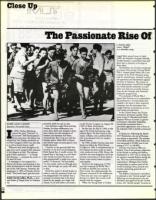
A British soldier
moves "illegals"
to a detention camp.
O
RABBI DAVID GEFFEN
Special to The Jewish News
I
n 1890, Nathan Birnbaum
coined the term "Zionism" in
his journal "Self Emancipation."
Seven years later, the phrase was
adopted by the Zionist movement at
its First Congress (1897), but the idea
is as old as Jewish history itself.
Wherever they lived throughout the
ages, Jews never accepted their existence
in the diaspora as final. The ultimate
goal of their aspirations — in liturgy
and literature — remained the return to
the land of Israel.
A campaign to win support for a
Zionist movement was launched in the
wake of emancipation and the national-
ism of the 19th century. However, the
appearance in 1896 of Theodor Herzl's
book "The Jewish State" gave the most
Rabbi David Geffen, Ph.D., is spiri-
tual leader of Temple Israel in Scranton,
Pa.
5/1
1998
88
powerful uplift for such an idea.
Anti-Semitism made Heal and Max
Nordau, his close collaborator, con-
scious Jews. Both were steeped in Euro-
pean culture, but the resurgence of
modern anti-Semitism hurt them
tremendously. But it was not until the
Dreyfus trial in 1894-1895 in France
that Herzl's hopes of emancipation were
finally shattered.
Contrary to the general belief that
hostility to the Jews would disappear,
Herzl feared that it would worsen. He
hoped that in the long run anti-Semi-
tism would not harm the Jews and
that educationally it might even prove
useful. "It forces us," he concluded,
"to close ranks, unites us through pres-
sure, and through our unity will make
us free. "
Herzl first spoke to Jewish leaders in
order to raise the necessary funds, but
was disappointed. He realized that a
national movement had to be shoul-
dered by the people, not single indi-
viduals. So he and others convened a
world Zionist Congress on August 29,
1897 in Basle, Switzerland.
By the time he died in 1904, at the
age of 44, Herz! had become a leg-
endary figure. He had turned a mys-
tique, a dream, into a political force,
the most dynamic force in modern
Jewish history.
By 1900, socialist Zionism came into
being just before the Third Zionist
Congress in 1900. It maintained that in
the diaspora the Jews could not lead a
truly productive way of life. Hence, the
solution was mass emigration and a ter-
ritorial concentration in Eretz Israel to
found a new society based on justice
and equality.
Between the beginning of 1904
and the outbreak of World War I
35,000 to 40,000 Jews moved to
Eretz Israel. But diplomatically the
Zionists remained in the wilderness.
There was not even one capital in
Europe to which they could confi-
dently look for support.
When the Young Turks in Turkey
staged their second coup in April,
1909, the situation changed radically.
Turkey became a centralized state and
Jews were a minority to be kept in
their place.
Nonetheless, the Zionists continued
to protest their loyalty. During World
War I, Ahmed Jamal Pasha, the Com-
mander of the IVth Ottoman Army,
and his subordinates, initiated a policy
of oppression and banishment against
the Jews in Palestine. His system of
mass deportations would have brought
the whole Jewish settlement to com-
plete ruin had not powerful interces-
sions by the German and American
embassies stopped him.
The outbreak of World War I
placed the Zionists in an unprecedent-
ed predicament. As individuals they
needed to be loyal to their respective
countries, but the movement was
caught between warring lines in Ger-
man lands and elsewhere.
In the United States, the Zionist
movement developed rapidly. With
jurist Louis D. Brandeis and Rabbi
Stephen Wise as its heads, it gained
prominence. Brandeis' leadership
turned the movement from a
parochial organization into a force to
be reckoned with in Jewish communal
life.
In Russia too, following the March
1917 Revolution, the rise of Zionism
was almost as spectacular. The number
of enrolled members, which before the
war amounted to 25,000, rose in the
spring of 1917 to 140,000.
Zionism even had an effect on
Britain. One of the primary objectives
of the British in issuing the Balfour
Declaration in 1917 was to swing Jew-
ish opinion towards Britain during the
war. This was achieved beyond all
expectations. Messages from Jewish
communities in various parts of the
world including China, poured into
London expressing gratitude and
appreciation.
The Balfour Declaration specifical-
ly referred to the "Jewish people" and
following its incorporation into the
Mandate and approval by the United
States, the "Jewish people" became an