

At The Fork In The Road
Jews changed their world forever by taking destiny into their own hands.
Now what?
as well. In 1948, there were 600,000
Jews there; today the number is 4.8 mil-
lion, an eight-fold increase in 50 years.
Economically the story is similar. In
t the recently concluded
1998, Israel's Gross Domestic Product is
annual March conference of
$96
billion with exports of more than
the Israel Democracy
$30
billion.
Institute, Ehud Barak, the
Politically,
Israel's most reliable ally is
Israeli Labor Party leader succinctly
the
only
remaining
superpower and the
remarked, "With Israel celebrating its
nation is in the midst of ending parts of
50th year, we [Jews] are at a crossroads."
the brutal Arab-Israel conflict — on its
For Israelis and diaspora Jews, he sug-
terms. The negotiating process may be
gested resolution and harmony of four
slow and tortuous, but Israel makes the
interrelated issues: achievement of secu-
choices, negotiating more with itself
rity, a stable peace, social justice, and
than with the Palestinians.
unity of the Jewish people. Israel is
Clearly, for the 13.5 million Jews in
working on the first three; the last one
the
world, three quarters of whom live
effects American Jews as well.
in the United States and Israel, this is a
Barak's confidential tone reflected
new era. After the Holocaust, both
what we all know, but yet sometimes
communities flourished. Diligence,
take for granted: Whether in Israel or in
communal dedication, and resourceful-
the United States, Jews are a free people.
ness brought us to this moment.
They are assimilating into their immedi-
Along the way, an Israeli and
ate environments. Worldwide, Jews are
American
Jewish synthesis and symbio-
more in control of their our own des-
sis
emerged.
American Jewish political
tiny than at any previous time in their
influence
aided
Israel's quest for strong
history.
philosophical, economic, and military
No monarch, pope, czar, mufti or
assistance from successive U.S. adminis-
dictator determines the Jewish future;
trations; Israeli political and military vic-
no U.N., OPEC, or great power tells
tories pumped pride into American
Jews what to do, or when to do it. The
Jews.
Israel became a religion for many
Arab economic boycott of Israel is
and
American
Jews became an essential
essentially over. No one tells Jews when
ingredient
in
Israel's
acquisition and
to be inside the ghetto walls. Like the
retention
of
power.
rest we stand in line for Miller time, and
So if these are birthday years for
make mall time. For court time and tee
Zionism at 100 and Israel at 50, Jews
time we build our own.
have had their cake and are eating it
Though constituting 2.3 percent of
too. Yet, the majority of world Jewry is
the American population, in per capita
at a crossroads.
numbers Jews are far in excess of their
At the century's start, European Jews
numbers in the general population in
were
systematically abused: synagogues
law, business, education, finance, tech-
and
Jewish
institutions burned, villages
nology, medicine, arts, letters, etc. Jews
hold 10 percent of the U.S. Senate seats, pillaged, and then came the ultimate
effort at organized state-sponsored anni-
8 percent of the Congressional seats,
hilation. Lesser degrees of incidents, but
dominate policy-making in the Arab-
still painful, were prevalent in Arab
Israeli negotiating process, and are in
lands. In America, Jewish civil rights
huge numbers in every branch of local,
and equal access to public institutions
state, and federal government.
were
curtailed.
In Israel, the numbers are impressive
Some Jews responded by taking their
destiny into their own hands. A small
Dr. Kenneth W. Stein is professor of
Near Eastern history and political sci-
minority rallied around the Zionist idea.
ence at Emory University, as well as
Creating a national territory was the
director of Emory's Middle Eastern
alternative to intimidation and assimila-
Research Program and the Institute for
tion.
But from its infancy and adolescence,
the Study of Modern Israel.
DR KENNETH W. STEIN
Special to The Jewish News
A
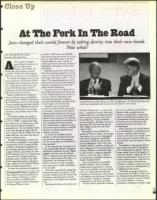
Yitzhak Rabin and Bill Clinton in 1994. For fifty years, the United States has been
Israel's most dependable ally, but Israel is very much its own country.
Zionism's ultimate call — to live in the
land — appealed to the few. Most Jews
preferred the fruits of enlightened toler-
ance in western societies, even when it
was problematic. Notions of streets
paved with gold in Brooklyn were more
appealing than kibbutz-living among
Arab villages outside of a new town
called Tel Aviv.
Meanwhile, modern Hebrew lan-
guage and literature, dead a century ago,
were reborn. As a society of geographi-
cally diverse immigrants, the Jewish
community of Palestine did not have
just one ideological center. They were
socialist, Marxist, capitalist, secular, cul-
tural, religious and every permutation in
between. Differences abounded: right
vs. left, secular vs. religious; expel the
Arabs or work with them. Only the
recurring enemy, regardless of quarter,
buried multiple discord.
Time was devoted to securing the
Jewish homeland. Zionist founders
worked almost exclusively in overcom-
ing Ottoman, British, and Arab opposi-
tion to an independent Jewish state.
Qualities of determination and commu-
nal solidarity were the means. Virtues of
improvisation, discipline, consensus,
manipulation, and secrecy prevailed.
As such, abstract principles of liberal-
ism, such as tolerance and individual
freedoms, did not guide the early
Zionists or Israeli leaders. Democratic
values were beneficial according to the
circumstances. Security concerns took
precedence over press freedoms; the
quasi-sacred status of the army was
unchallenged.
When required, the judicial system
was subordinated to national security
interests. Equality before the law
could not be stated if an Israeli consti-
tution were to be written; Arab citi-
zens of Israel were not equal to Jewish
Israelis.
Nonetheless, in the process of form-
ing a Jewish state, Jews as individuals
were transformed as a people. They no
longer merely lived on the margins of
insecurity. Zionism taught Jews how to
obtain and wield power. Each acre pur-
chased, settlement built, institution cre-
ated, and immigrant absorbed con-
tributed to a dynamic notion of Jewish
successes. Each was a building block in
establishing Jewish power.
Ultimately, power gave Israel and
Israeli leaders the ability to make choic-
es. Modern Jewish self-determination
was a newly minted currency. As Israel
secured its viability as a state, it
increased its willingness to make tough
5/1
199E