

"I know from personal contact with
many families that the Israeli commu-
nity in the United States is following
the American Jewish community," he
says, adding, "It goes both ways, how-
ever. A lot of Israeli families come not
religious, then become more observant
here."
Hannan Lis is one of the latter.
"I grew up secular, but when I came
here I realized the only way to feel
Jewish is to act Jewish through some
sort of religious practice," says Lis, 38,
a member of Adat Shalom. "Religion is
the glue that holds us together. Jewish
culture alone won't sustain us."
"If the country is run by Jewish aya-
tollahs, then it wouldn't still be my
country."
Staunchly secular, Lax does not
affiliate with a synagogue and sent his
children to public, not Jewish, schools
here. "I don't accept the religious sys-
tem, and we taught our kids the Israeli
heritage side at home," he says.
But Lax, who associates mainly
with other Israelis is an avid reader
of Israeli literature and consults
Israeli news media several times a
day, is troubled by the prospect that
his children may "view the United
States as the only place they know."
And he yearns for the "openness" of
Israeli society. "The standard of liv-
ing is higher here, but the quality of
living is higher in Israel ... People
tend to lock themselves in their
houses here."
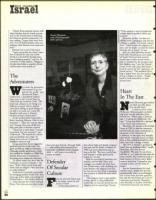
Noemi Ebenstein,
with old photographs
of her parents.
The
Adventurers
e're from the generation
that wanted to go out
and see the world," says
38-year-old Ronit
Gutkovitch, a Southfield resident
who came to the United States in
1989 with her husband, Coby. "We
both had a dream to try living in a
different country. All our friends
came back telling us good things, so
we did it, we took our 6-year-old
daughter and came to Detroit
because we had a friend here."
As the Gutkovitches found jobs —
Ronit teaching Hebrew, Coby in con-
struction — what was "just an adven-
ture" became their way of life and
they now plan to become citizens.
"There was a time when I wanted
to go back, but not anymore," says
Gutkovitch. "We missed the culture
and our families, but today I'm
happy here and our 14-year-old
daughter wants to stay."
Living away from home triggered a
spiritual quest for Gutkovitch, who
grew up with no religious education.
Although initially apprehensive when
she enrolled her daughter at Hillel Day
School, Ronit now is interested in
becoming more religiously observant.
"In Israel, either you don't like the
Orthodox or you're Orthodox," she
says. "Here I find myself more and
more close to religion. Here you have
to make Judaism."
Gutkovitch is partially responsible
for bringing another Israeli over. Four
years ago, Edna Sable was visiting the
Gutkovitches — her distant relatives
— when she met her future husband,
Brian. Now they are next-door neigh-
IV
5/1
1998
22
Heart
In The East
oemi Ebenstein gets choked
up when she talks about
how she left Israel.
A child survivor of the
Holocaust, Ebenstein grew up believ-
ing Israel was the only place Jews
should live. "When I got to Israel at
age 7, I started my childhood," she
says. "Living here feels like a betrayal
of my values and convictions."
Ebenstein, 56, moved to the United
States in 1963 so that her American
Jewish husband, Sam, could pursue a
doctorate at the University of
California. At the time, they thought
they would eventually return to Israel.
But, as they settled and had four chil-
dren, Sam had a change of heart.
"By 1977, I wanted to go back to
Israel, but my husband didn't," recalls
Ebenstein, who now lives in
Southfield. "He said, 'Go see if you
still like it,' so I took the kids there for
three months. But I realized Israel is a
hard country to live in, and I didn't
want to force him. I wanted to stay
married to him, not the State of
Israel."
But her homesickness for Israel
remains acute, despite the fact that
professionally (she is a psychologist)
the United States has been good for
her and that her friends are a mix of
Americans and Israelis. Ebenstein,
who identifies as modern Orthodox,
visits Israel frequently and dreams
N
bors and close friends, although Sable
— who suffers from homesickness
and lacks confidence in her English
skills — still hopes eventually to
return to Israel.
Defender
Of Secular
Culture
F
orty-six-year-old Doron Lax
is no longer certain he will
return to Israel.
A West Bloomfield resi-
dent whose high-tech Israeli company
sent him and his family to Detroit in
1989, Lax never planned to stay as
long as he did. "But once you've been
here beyond a certain point you're
locked in," he says.
Both his sons attend American uni-
versities, and his wife, Dina, now
manages a successful real estate busi-
ness. Furthermore, with escalating ten-
sions between the religious and secu-
lar, Lax worries that Israel is changing
into a society in which he won't want
to live.
"The religious want a state similar
to Iran, which is a big problem for
Israelis like me who are Jewish but not
religious and not practicing," he says.