

a regional director, eventually landing
in Detroit. Today, at 84, he serves as
the executive vice-president of the
Zionist Organization of America-
Metro Detroit, which has its head-
quarters in the Zionist Cultural Cen-
ter in Southfield.
His dream of settling in Israel never
died. In 1982, he and Bella moved to
Jerusalem, where Leikin went to work
as a consultant with the Israeli Foreign
Ministry. When his wife fell ill, they
came home.
"I would have stayed, because I felt
at home in Israel," he said.
Yet, Leikin is troubled by the
materialism of Israeli society, an
effect of cross-cultural pollination, in
his view. His brother-in-law in Israel,
he said, is a "real capitalist" who asks
him when he visits what kind of car
he drives and how much his house is
worth.
But Leikin is more disturbed by the
"lost generation" of younger Jews who
do not identify with Israel or with
Judaism. He is under no illusions that
a new generation is about to pick up
the torch he has carried for over 60
years.
"I think Israel's survival is ensured.
Israel doesn't need American financial
support," Leikin observed. "But
American Jewish survival is in doubt."
IV
aking up early one
morning at the Farband
Camp in Chelsea, Eve-
lyn Noveck looked out
at a sunrise that appeared to her as a
fire in the sky. She was certain Arabs
had attacked the camp.
Such was Noveck's girlish frame of
mind, the product of an upbringing
by two fiercely devoted Zionists who
spent a good part of their time agitat-
ing for workers' rights and a Jewish
homeland.
David Sislin, Noveck's father, sat
on boards and wrote columns for
newspapers, including The Daily For-
ward, and speeches for Labor Zion-
ists. Sophie Sislin was a "tough and
feisty" woman who shared her hus-
band's passions and made it her busi-
ness to recruit children to go to the
Farband Camp, a forerunner of the
Fresh Air Society. The couple also
routinely hosted international politi-
cal figures in their home, including
Golda Meir, to whom Nov ck's
mother regularly sent cigare es and
coffee.
"When I was young, they filled us
with this Israel business," Noveck
recalled. She remembers going to a
donor luncheon for Pioneer Women,
now Niamat, at the age of 12.
Today, slie takes her granddaughters
.„
to the annual event.
When she was 18, Noveck thought
she would make aliyah. A scholarship
to the University of Michigan
deferred her plans, but she did attend
a "training farm" in New Jersey dur-
ing the same year — 1940 — and
learned she wasn't "equipped" to
work on a kibbutz or moshav in
Palestine.
"I hated every minute of it. I knew
I wasn't cut out for hard physical
Still, Noveck said, she is ever the
"kuchlefel" — the spoon that stirs
the pot — and is committed to the
causes Na'amat, Hadassah and ORT
have taken up, even if she doesn't
work as hard nowadays.
"We're still proselytizing — all of
us," she said.
r. Jerome Kaufman, in his
second year as president of
the ZOA-Metro Detroit
District, is younger than
Ezekiel Leikin by more than two
decades, and in politics, considerably
D
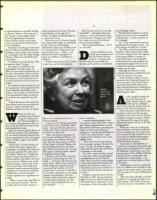
Evelyn
Noveck: A
pioneering
spirit.
labor. I'm a coward, let's face it,"
Noveck laughed.
It wasn't until 1968 that she finally
visited Israel, and, "I felt like I came
home," she said. She even had tea at
Golda Meir's house. Noveck returned
to Israel one other time.
Today, she serves as president of
the Council of Pioneer Women, but
acts mainly as its director of educa-
tion. She also has served as president
of the League of Jewish Women, the
Jewish Historical Society of Michi-
gan, ORT and Na'amat. For 36 years,
she taught at Detroit public schools,
including Redford High.
Noveck is proud of the work she
has done in promoting the State of
Israel — she boasts that Na'amat sup-
ports about 1,000 nursery schools in
Israel, along with agricultural and
vocational high schools and after-
school clubs — but she is disturbed
by life there. She points to the raging
debates over pluralism, what she
believes is the second-class status of
women in Israeli society and "the
power of the minority to dictate to
the majority."
more outspoken.
A retired ophthalmologist, Kauf-
man spends much of his time at either
the Zionist Cultural Center or at his
Bloomfield Hills home, pounding out
letters to editors and newspaper
columns or meeting with publishers to
"hock" them about stories or pho-
tographs that he believes carry a bias
against Israel.
"That's where I feel I .gan do best
for our people, trying to `de-slant' the
news;" he said. His battle is against
"knee-jerk liberalism" that he believes
is prevalent in the media.
- The ZOA, which Kaufman joined
13 years ago, "takes an unapologetic,
unabashed stance on the State of
Israel. We've found that many people
in the community have become com-
placent. In actual fact, Israel is in a
tremendously precarious position. It is
a long way from being a superpower,"
he said.
Kaufman traces his zeal to the Six-
Day War in 1967. He was poised to
fight for Israel but didn't because the
State Department threatened to strip
Americans of their citizenship if they
served foreign armies.
He has been to Israel six or seven
times since, but he never considered
making aliyah. A major hindrance is
the language.
But, "I get tremendous emotional
satisfaction from going to Israel. I go
over and get an Israel fix," he said.
The ZOA, aside from providing
Kaufman with a forum for his politi-
cal work, is fairly active. The organiza-
tion's annual Balfour Concert is a
major fund-raiser, and it regularly
hosts lectures by local, national and
international figures. The ZOA also
continues to provide scholarships to
youths to go to Israel.
Although the ZOA has 1,500
members, Kaufman is disheartened by
a lack of interest in the cause.
"Labor Zionism is dead," he pro-
nounced. And, "political Zionism has
lost its potency in the United States.
Americans don't think Israel needs
help, and the Holocaust is fading from
memory. Arabs have been successful in
subverting the truth."
s the youngest member by
far on the board of the
Labor Zionist Alliance, Judy
Loebl and her colleagues
used to joke that she would always be
the one to do the Four Questions.
Now in her 40s, Loebl believes she
probably is still one of the younger
members of the LZA. But she is heart-
ened by a resurgent interest in Habon-
im, the youth-led wing of the Labor
Zionist movement and one of her life-
long passions.
There was a time not so long ago
when Habonim, of which Loebl now
serves as chairperson of its adult advi-
sory committee, had receded from the
contemporary Jewish consciousness,
becoming as quaint as the socialist
ideals the group clung to.
Money ran out for shalichim, or
community emissaries from Israel, and
group activities dropped off. A veteran
of Habonim, Loebl stuck it out, even
though many of her childhood friends
had moved on as adults after they
decided not to make aliyah — an
expectation, tacit and explicit, of the
movement.
Loebl's plans to move to Israel and
live on a kibbutz were waylaid by mar-
riage, but she stayed active. And today,
she is proud to be a part of Habonim's
revival.
"We went from sporadic activities
in Detroit to having meetings every
other week," said Loebl, the owner
of A Plus Travel in Southfield. Three
A