
At The Movies
A struggling Israeli film industry.
ALAN ABRAMS
Special to the Jewish News
lthough
movies and
Jews are often
intertwined in
people's minds, that has-
n't been the case in Israel.
In 50 years of state-
hood, the Israeli film
industry has produced
fewer than 400 films,
said film historian Amy
Kronish, curator of
Israeli and Jewish film at
the Israel Film
Archive/Jerusalem Cine-
matheque and author of
a book on Israeli film-
making.
Kronish was at Bran-
deis University in April
as guest co-curator of an
Israeli film festival orga-
nized by the university,
the National Center for
Jewish Film (NCJF) and
the Consulate General of
Israel to New England. A
few weeks earlier, she
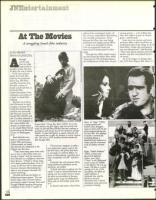
A scene from "I Love You, Rosa" (1973). Set in the
shared co-curator status
19th century, this film begins with the recently wid-
at the Israeli Film Festival owed 21-year-old Rosa (Michal Bat-Am) waiting in
presented at the Kennedy accordance with Jewish law for her husband's younger
Center in Washington,
brother, 12-year-old Nissim, to attain maturity and
D.C.
either marry her or offer her freedom to marry someone
Both festivals were
else. This was a 1972 Academy Award nominee for
held to commemorate
Best Foreign Film.
Israel's 50th anniversary.
Unfortunately, _ no Israeli
"Government support is really a
film festivals are scheduled in the
very
important aspect, and in the
Detroit area this year.
last
few
years, the policy has been
"There were many years when only
to
cut
back
on cultural affairs. In
one or two or three films were pro-
terms
of
filmmaking,
subsidies have
duced in Israel," said the American-
been
completely
cut
off,"
said Kro-
born Kronish in a telephone interview
nish.
from Boston. "[Then] in recent years,
Currently, the only dramatic films
we've been producing about 12 or 15
being
made and subsidized are for
a year. In the last two or three years,
television,
she added.
however, dramatic filmmaking has
"I
think
television is taking over the
taken a very dramatic decrease. It's
world. I used to think Hollywood was
almost shocking."
taking over the world. Even in Israel,
Kronish attributes the decline to
the same as everywhere in Europe,
slashed government grants. "You can
people
prefer to go see Hollywood
barely make a film in Israel without
films
and
not the locally made prod-
government support because there aren't
uct."
enough Hebrew-speaking film-going
In Israel's early years, when films
audiences in the world to support it.
A
5/1
1998
124
reflected the sociological reality of
the country, independent filmmaking
was virtually nonexistent. That's
because the films that were being
produced were largely group efforts
— with a lot of people involved,
a lot of cooperative work and
some kind of institutional involve-
ment.
Through the 1960s, Israeli cinema
was dominated by heroic films which
"expressed the War of Independence,
the establishment of the state, the pio-
neering period — a lot of films that
show war widows as part of a heroic
genre," said Kronish.
Some were war movies, and some
adventure films, where you'd have an
Arab/Israeli kind of spy thing. In all of
those films, "Arabs were portrayed as
very one-dimensional," said Kronish.
"They were always enemies across the ,
border, and they were played by Jew-
ish actors."
All of this began to change after
the 1973 Yom Kippur War when "it
Above: In "Siege" (1969),
a young woman and
mother (Gila Almagor),
comes to terms with the loss
of her husband during the
Six-Day War. Her attempts
to resume a normal life,
including dating, is
haunted' liy her status as a
widow and the continued
circle of violence around
her.
Right: "Sallah Shabbati"
(1963), written and
directed by Ephraim
Kishon, stars Topol
("Tevye" in the Hollywood
screen version of "Fiddler
on the Roof,. He is at top
center. The film is a satiric
comedy set in the 1950s
that follows the efforts of
Sallah Sabbati, a
Sephardic Jew, and his
family to extricate
themselves from a dismal
absorption camp and secure
permanent housing.
•
Scanned image of the page. Keyboard directions: use + to zoom in, - to zoom out, arrow keys to pan inside the viewer.
May 01, 1998 - Image 124
- Resource type:
- Text
- Publication:
- The Detroit Jewish News, 1998-05-01
Disclaimer: Computer generated plain text may have errors. Read more about this.