
Lertainment
Open Sesame
rial that they choose from the Amer-
ican series, mostly animation and
live action film [with dubbing], and
then rejects the American street
scenes because they are very cultural-
ly specific to America," explains
Bernstein, who has been part of the
Children's Television Workshop for
20 years.
"They create their own street scent
and their own cast of characters to
deal with their own cultural, educa-
number of programs has to do with
tional and social issues."
the fact that we're doing a project that
Both Mideast production teams let
is incredibly complex. The Children's
Big Bird fly away. Instead, the Israelis
Television Workshop co-produces 18
created a porcupine, who is compared
versions around the world, but what's
to a Sabra, "prickly on the outside an
unique to this project is working with
sweet on the inside." The Palestinians
two languages, three religions and two
came up with a rooster to show pride
production groups.
"The biggest surprise is how deeply
"Israel Educational Television has
both the Israeli and Palestinian teams
been in production for 30 years [even
felt about the importance of this pro-
with an earlier 'Sesame Street' ver-
ject," Bernstein says. "They could
sion], but the Palestinians never pro-
have stopped work at any time for any
duced television. We suggested that
legitimate reason, but they kept on
the Palestinians produce less and that
going.
we spend more time with them trans-
"The Israelis withdrew and made
ferring technology and skills."
space for the Palestinians. The Pales-
All of the Palestinian materials are
tinians stepped forward and said it w
being incorporated into the Israeli seg-
hard, but they could learn.
ments so an Israeli child watching any
"Each group had slightly different
of the shows is likely to see an Israeli
political takes. The Israelis would say
street and a Palestinian street and hear
there's no reason why they can't have
two languages, Hebrew and Arabic.
the children and puppets singing with
The 15-minute Palestinian broad-
each other and having fun with each
casts basically will deal with general
other. The Palestinians would say it's
Palestinian curriculum interests
going to take a couple of years to get
and have some crossover
to singing and dancing."
segments.
Three research teams will evaluat
"Each country
the impact of the two series. They wi
that we work
explore the initial attitudes and
with takes a
knowledge levels of 100 Israeli chil-
body of mate-
dren, 100 Palestinian children and
100 Israeli-Arabic children. After the
broadcast season, they're going to test
again to see how those attitudes and
knowledge levels have been affected.
In his travels back and forth to the
Mideast, Bernstein was deeply move
by one-on-one conversations with
children involved in the taping.
A Palestinian girl, told Bernstein
was the American producer, said she
did not believe that, insisting his
New cooperative versions of "Sesame Street" seek to
bridge the cultural gap between Israelis and Palestinians.
SUZANNE CHESSLER
Special to The ft-wish News
IV
hen the Israeli "Rechov
Sumsum" and the Pales-
tinian "Shara'a Simsim"
made their television
debuts on April 1, it was clear that the
newest versions of "Sesame Street" had
separate identities.
It also was apparent that the two
programs were linked in a special way.
Crossover segments, taped in both
Hebrew and Arabic and featuring an
interpreter, spotlight Israeli and Pales-
tinian characters visiting with each
other.
The make-believe situations,
designed to capture common and
unique characteristics of people from
both cultures, set these two series
apart from other versions broadcast in
more than 100 countries.
Producers from the Children's Tele-
vision Workshop, which created
"Sesame Street," have been
working closely with production
teams from both series to
design programs that will
help break down barriers
and establish friend-
ly and respectful attitudes among all
the shows' young viewers.
Lewis Bernstein, executive producer
for the series, was present as the series
were introduced.
"We invited Israelis and Palestinians
who worked on the productions and
their children as well as members of
the international press, and the chil-
dren watched the shows without being
distracted," Bernstein says. "There was
a sense that we did something impor-
tant, and we experienced excitement
and pride."
The programs have been in the
works for two years. The idea came to
Children's Television Workshop staff
as they saw the late Yitzhak Rabin and
Yassir Arafat shaking hands on the
White House lawn.
"There are 60 half-hour programs
that will be broadcast by Israel Educa-
tional Television, and there will be 20
programs broadcast by the Palestini-
ans," explains Bernstein, who has
a doctoral degree in com-
munications
research.
"Much of the
difference
in the
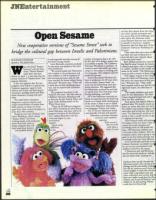
Clockwise from top left: Kareem, the
; his
Palestinian rooster, who is proudo
plumage and his punctuality; Oo ik,
who like his American uncle Oscar the
Grouch delights in trash, dirt and loud
noises; Dafi, a pig-tailed 3-year-old,
whose enthusiasm and curiosity hel p he
learn new Arabic words from her
Haneen; and 3-year-old Haneen, who
delights in art and learning Hebrew
words from her friend Dafi.
5/1
1998
122
Scanned image of the page. Keyboard directions: use + to zoom in, - to zoom out, arrow keys to pan inside the viewer.
May 01, 1998 - Image 122
- Resource type:
- Text
- Publication:
- The Detroit Jewish News, 1998-05-01
Disclaimer: Computer generated plain text may have errors. Read more about this.