
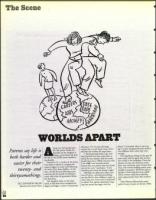

WORLDS APART
Parents say life is
both harder and
easier for their
twenty- and
thirtysomethings.
JILL DAVIDSON SKLAR
Special to the Jewish News
4/24
1998
90
lmost two full decades past
her 20s, Janice Tracht can
honestly say her daughter is
doing a much better job than
she did in one of life's most transform-
ing decades.
Married at 21, a mother at 24, Janice
went back to school to complete her
master's degree in social work following
the birth of her three children. At the
time, she felt she was following a pre-
selected path for herself, emulating in
many ways what the generation before
her had done.
Her daughter, Julie, on the other
hand, in the same time completed her
degree and began a career in elementary
education. The 24-year-old single
woman has a much better sense of her-
self than her mother did, says Janice.
"I did things backwards. I got mar-
ried, had kids and then went back to
school for my master's. Julie has made
herself what she is. While I became who
I am whip I was married, she has
become her own person from her family
and on her own," says Janice. "I love
watching and seeing her doing it right."
Although one generation apart, par-
ents of twenty- and thirtysomethings
say that life for their children is easier in
some ways, but much more complicated
in others. Few parents admitted to laps-
ing into stories that begin with the
phrase "I remember when I was your
age"; in fact, all agreed that the world is
a lot different from when they were
younger.
One significant change in the past 30
years came with the gains that women
have made in the workplace. Once the
domain of men, the American work-
place now comprises more women than
men, with women holding nearly every
possible occupation. While the path to
equality is becoming less of an uphill
climb, women today have infinitely
more opportunities than their mothers
did.
Didi Wainess followed the career
path of many women in the late 1960s