

1948, Zionism became a capital
crime, and Jews were hanged in Bagh-
dad's central square to the delight of
cheering crowds.
Israel moved to rescue the Iraqi
Jews, tapping Ben-Porat — who had
walked and hitchhiked from Iraq to
Palestine in 1945 — for the agency
facilitating "illegal" emigration. From
1949 to 1951 Ben-Porat headed a
team of emissaries that evacuated
104,000 Iraqi Jews in Operation Ezra
and Nehemiah; another 20,000 were
smuggled out through Iran.
In the years after the 1967 Six-Day
War, a new round of persecution
began. Up to 5,000 Jews managed to
escape through Iran with the aid of
Kurdish leader Mustafa Barazani and
his sons.
The Cohens are among some 75
Jews who have fled Iraq in the last five
years, according to Ben-Porat. Most of
them have joined Iraqi Jewish commu-
nities in Amsterdam or London. About
20 have come to Israel, including some
who arrived after the Cohens, but are
reluctant to meet the press.
The Jewish Agency refuses to com-
ment on efforts to rescue the Iraqi
Jews or answer questions as to whether
the organization is involved in any
way.
"There are hundreds of Iraqis cross-
ing the border to Jordan every day,"
Ben-Porat says. "If among them there
are two or three Jews, no one minds.
But if we talk about how they left, the
government will start to keep its eye
on them."
For his part, 71-year-old Naddam
Cohen has mixed memories of his
native country. It is where he raised a
family and built a successful business
importing and exporting textiles. He
was such close friends with his
Moslem neighbors that they allowed
their teenage daughters to travel alone
with him in his car, a level of trust
rare in that traditional society.
As a youth, Naddam studied briefly
in a yeshivah. Now it's illegal to teach
Hebrew in Iraq and the younger gen-
eration-knows little or nothing of its
religious traditions.
Naddam grew up in a community
with 53 synagogues. Today, Baghdad's
Great Synagogue serves as a warehouse
for Moslem merchants. The Meir
Tweg Synagogue, where Naddam
prayed on Shabbat, is the country's
only Jewish house of worship still in
use. When Naddam emigrated, a part
of the community's soul went with
him. He was the last Cohen in Bagh-
dad.
4/24
1998
88
her grades because she was a Jew.
Classmates mockingly called her
Israeli, following that with talk of
their desire to burn the Zionist state.
Sometimes she would give her last
name as "Bat Naddam," Naddam's
daughter — a moniker of more
ambiguous origin than Cohen.
"I grew up hating Iraq," Vera says.
"In school, they always let you know
that you're Jewish, that you're differ-
ent. I was embarrassed."
The taunting became more intense
at the Baghdad university where Vera
studied physical therapy. The campus
is a center for Palestinian students. If
Vera socialized with them, she might
be suspected as an Israeli spy. If she
avoided them, she would be criticized
for being a Jewish snob. The Palestini-' -\
ans devised a game to see who could
find the right barb to make Vera feel
like a dishrag on any given day.
In classes, Vera often found herself
listening to lectures in which profes-
sors verbally attacked Jews, describing
them as untrustworthy backstabbers.
Her friends asked if it was true that
Jews drank gentile blood on holidays.
"I couldn't speak when I heard
those things," Vera says. "I knew if I
answered back [in the lectures] they
could take me and my family and kill
us. So I stayed quiet, but inside I felt
terrible."
Instead, she told her classmates,
"treat me like a human being and you
will see that a Jew also is a good per-
son." She says she eventually made
many close friends.
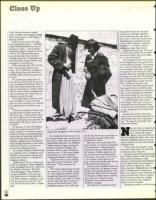
Iraqi Jewish immigrants arrive in Israel, 1 95 1.
But Naddam's fond memories also
are tempered with more somber recol-
lections. In 1968, when the regime of
Ahmad Bakr and then Vice President
Saddam Hussein began abusing the
Jewish community, Naddam was
tossed in jail for a year. During the
next few years, 14 Jews were hanged
and another 51 were murdered,
including Naddam's brother-in-law.
"The Jews were accused of being
the spies in every revolution," Ben-
Porat says. "This was always the
excuse."
The Cohens' first attempt to leave
the country, in 1973, ended in disas-
ter. Their eight-year-old son, David,
boarded the plane with Jacqueline's
mother, Naima, and made it to Israel.
At the airport the secret service sent
the rest of the family home. Then
Naddam's property was confiscated
and he was thrown into prison for sev-
eral months; Jacqueline fasted and
prayed for his release.
After they were finally freed, Nad-
dam and Jack were beaten occasionally
by the authorities. The government
ordered the closing of the family tex-
tile business; Naddam eked out a liv-
ing as the accountant for the Jewish
community. He would not see David
or his mother-in-law again for 23
years. Naima died shortly after the rest
of the family arrived last year.
Today a retiree, Naddam smiles eas-
ily but talks little. He appears uncom-
fortable with probing questions. Vera,
poised and stylish at 25, has become
the family's unofficial liaison with the
press. She, too, misses her many
friends, but her recollections lack
Naddam's nostalgia.
She tells of how teachers lowered
ow that they no longer have
contact with Jewish neigh-
bors, many older Iraqis
appear to be overcome by a
sort of nostalgia for "their" Jews, miss-
ing their respectful behavior and eco-
nomic acumen, say the Cohen family
and Ben-Porat.
"There were some people in Iraq
who knew what a Jew was and loved
me because of it," Vera says.
During the Gulf War, paradoxically,
the Cohens' relations with their neigh-
bors seemed to improve. Many
Moslems and Christians fled Baghdad
to stay with family in less dangerous
areas. With no relatives to receive
them elsewhere, Baghdad's Jews didn't
leave. Unbeknownst to Iraq's Jews,
Ben-Porat said his center informed the
American-led Desert Storm coalition
of the location of the Jews in Bagh-
dad, ensuring that their neighbor-
hoods were not bombed.
During that conflict, just like during
N