

At Kiwi Moshe, a group of
women and their teacher
have been studying together
more than five years.
JULIE WIENER
StafrWriter
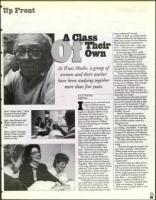
Above: Nathan Roth: "They're
the greatest bunch of ladies
I've been associated with."
Right: Anne Rottman and
Marge Charnes listen as
Nathan Roth explains a con-
cept.
Below: Dolores Greenspan,
Marsha Trimas and Leba
Rautbort enjoy a lighter
moment in class.
I
t started out as a 10-week crash
course in Hebrew literacy.
But it kept on going. Almost
six years after they first came
together to decipher Hebrew words
and phrases, five loyal learners —
women who range in age from 30-
something to 60-something — and
their pro bono instructor, Nathan
Roth, are still meeting every Sunday
morning at 9:45.
They gather around a table in class-
room number nine at B'nai Moshe, set-
ting down their styrofoam coffee cups
and battered green Hebrew books.
When the class began, none of the stu-
dents could read Hebrew; now they
tackle advanced grammar, but make
time for the occasional digression.
"It's a very informal class," said
Roth. "Sometimes we diverge onto
other subjects or talk about related
things. But we make progress."
On April 5, the class started out
practicing Hebrew possessive nouns,
then moved on to study the Passover
Hagaddah. When they read the words
to the song, "Dayenu," Marge Charnes
called out, "Oh, so that's what the
words look like. I always just sang it,
but didn't know what it meant."
This is the kind of moment that
Roth gets up early for every Sunday.
"It just gives me the greatest plea-
sure inside when I cite a psuk (verse)
from the service and they say, 'Oh
that's what it means,' and it's words
they've been saying all along, but they
never understood," he said.
Roth, 73, grew up a yeshiva bocher
in Czechoslovakia, but his formal edu-
cation was cut short by the Holocaust.
He was deported to Auschwitz in
1944, and met his wife — also a sur-
vivor — after the war in a displaced
persons' camp in Germany.
Several years ago, after a varied
career as a ditch digger and plumber,
Detroit Free Press advertising manager
and finally vice president of W.B.
Doner Advertising, Roth retired.
But he remains active, playing a
leadership role at B'nai Moshe, report-
ing regularly for morning minyan and,
of course, the Sunday morning class.
"They're the greatest bunch of ladies
I've ever been associated with," he said
of his five students, adding that he looks
forward to seeing them each week "And
to me, two is a minyan. If just one per-
son shows up, I will teach her."
Fortunately for Roth, the class is
usually full. His "bunch of ladies" are
enthusiastic about Roth and the friend-
ships they have forged.
Anne Rottman never had a formal
Jewish education and joined the class
because she wanted to be able to help
her son with his homework "I had
dropped out of other classes before, but
this group was very unintimidating and
friendly," she said.
Marsha Trimas, who wanted to
learn to say Kaddish for her mother,
was a latecomer to the class, but, she
said, her fellow students made the
adjustment easy
"They were on page 83, and I was
just starting," she recalled. "It was hard,
but everyone helped me catch up. And
because of the dynamics of this group I
couldn't stop coming. I always leave here
feeling better than when I came in."
The class, which used to have two
male students as well, meets year
round.
"We meet through the summer and
never take a vacation," said Charnes.
"When people need to go, they go.
Then the class helps them catch up ...
We always say Nathan's wife should
appreciate us because we've made him
a patient man."
But Roth insists it's a labor of love,
and points out that he's a student as
well as a teacher each Sunday morning.
One of his students, Leba Rautbort,
teaches English grammar and composi-
tion at Oakland University, and she
helps Roth — who speaks three lan-
guages in addition to Hebrew and
English — fine-tune his English skills.
"Leba's my professor," he laughed.
"Without her, I wouldn't know a verb
from a proverb."
❑
4/24
1998
25