

A Just Soul
At a ceremony at the
Holocaust
Memorial
Center,
Israel
recognizes an
Austrian
woman who
risked her life
to save Jews.
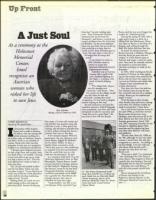
Rosa Schreiber
during a visit to Detroit in 1995.
HARRY KIRSBAUM
Special to The Jewish News
I
n December 1944, Andrew
Braun had to make a decision.
His father, who was among 200
Jewish prisoners working in a
slave labor camp in Neuhaus, Austria,
had fallen victim to an outbreak of
typhus. Along with other starving
prisoners, he was sent to a temporary
sickbay in an abandoned schoolhouse.
"I became quite desperate because
he had a high fever and couldn't keep
any food down," he recalled. "As long
as you were able to go out to work,
you had a chance to live." The sick
were allowed two weeks to heal, or
they were shot.
The 16-year-old needed medica-
tion for his father. There was only
one place to get it. "As we lined up to
work, you could see a little pharmacy
with a bell by the door indicating
night service," he said.
Risking death, he snuck out one
night during curfew and rang the
pharmacy's bell. Instead of shooing
4/24
1998
14
him away, a 31-year-old woman qui-
etly led him into another room and
told him to wait. A Nazi guard was
visiting, and she had to persuade him
to leave without letting him know a
prisoner had come to the door.
A few minutes elapsed. With the
guard gone, the son, taking an enor-
mous chance, begged for medicine
for his father. Within 10 days, a
healthy father returned to work.
"From that point on, she would keep
us supplied with food and medicine
that she would hide next to a dry
well near the pharmacy," he said.
In a ceremony held April 15 at the
Holocaust Memorial Center in West
Bloomfield, Tzipora Rimon, Israel's
Consul General in Chicago, present-
ed Yad Vashem's "Righteous Among
the Nations" award to the late Rosa
Freissmuth-Schreiber. Accepting a
certificate and medal on her behalf
was a grateful Dr. Alan Brown, the
teenage prisoner who came to
Schreiber for help that night.
"Undoubtedly, I was able to sur-
vive because of the extra food I got
from her," he said, holding back
tears. "Rosa Freissmuth-Schreiber
represents for me the hope for
humanity," said Brown, a retired eco-
nomics professor from the University
of Windsor. "In the worst darkness,
there was very little that we could see
that would give us hope that we
could survive. Rosa Schreiber gave us
hope. My only regret is that she is
no longer here to accept this
award."
A year before her death in
1996, Schreiber came to
Detroit to accept the
Holocaust Memorial Center's
Righteousness Award.
Schreiber was an Austrian
woman with a small child
and a husband fighting for
the Nazis — a woman with
much to lose by helping
Jews.
"The village had a reputa-
tion for rampant anti-
Semitism," said Brown. "Very
few people [in the' village] would
say that what she did was
admirable. Lacking that social
recognition, it's very hard to imagine
anyone helping in that way."
She hid medication and food for
countless prisoners, bribed SS guards
with marmalade, and when the Nazis
threatened to take her son away and
"teach him to be a good Nazi," she
sent him to live with her friends.
Dr. Alan Brown (foreground) speaks
about Rosa Schreiber at a ceremony last
week. Beside him are (from left) Rabbi
Charles Rosenzveig, director of the
Holocaust Memorial Center, Dr. Steven
Grant and Israeli Consul General
Tzipora Rimon.
Brown said the son never forgave his
mother for "abandoning him."
During the spring of 1945, after a
night spent lying in a ditch on a
killing field near Mathausen, libera-
tion came to Brown in the form of a
Russian tank rolling through the
field. His father died later that day.
In search for family survivors,
Brown returned to Miskolc, Hungary,
but only found an aunt and two
cousins. In 1949, Brown came to
America and began a career in acade-
mics. Years later, he married, received
his master's in economics from
Harvard, and began to work on his
doctorate.
In 1961, while working on his dis-
sertation in Vienna, he went search-
ing for the woman who saved his life.
Brown did not know her name, but
returned to Neuhaus and asked older
villagers if they remembered the
woman pharmacist.
One man who knew her said her
first husband died during the war.
She remarried and moved to another
village. Brown got her address and
began to write.
Over the years as they became
close friends, they took turns visiting
each other. His children looked for-
ward to seeing their "Tante Rosa."
On a visit to her Austrian home in
the mid-1990s, as Schreiber showed
Brown some old pictures from
Neuhaus, some documents fell to the
floor. Brown saw they were from the
Austrian government, dated 1946
and 1947, honoring Schreiber for her
heroism in rebelling against Nazi
atrocities and for supporting Jews
and other slave laborers with food
and medicine.
"All this time, from the 1960s to
the `90s, although we had very close
contact, I never knew that she was
recognized as a rescuer. According to
my knowledge, I was the only one
who knew what she did, and I
thought she only did it for me,"
Brown said.
"Rosa was a rebel," he continued,
"who challenged the Nazi Parry at
every chance. She stepped in front of
a guard who was beating a Jew and
demanded that he beat her instead."
Schreiber once told Brown, "I
only did what people should have
done."
Brown presented the Certificate
of Honor and Medal of the
Righteous Among Nations to the
Holocaust Memorial Center for dis-
play. ❑