

Dove Award
Dinner
/nent: songs that reinforce vocabulary
and promote learning about the holi-
days. He said he also uses humor to
explain things and tells jokes to gauge
his students' understanding.
On a recent Friday morning, after
practicing Pesach songs together,
Kaufman put his second-graders to
work writing Hebrew skits that try to
explain how Eve knew she was not
supposed to eat the fruit in the garden
of Eden. "Really, they're creating
midrash," explained
Kaufman. "This gives them
an opportunity to relate
meaningfully to the text."
While the children
worked in small groups —
occasionally cheating and
breaking into English —
Kaufman circulated, asking
"It's very big news when Moreh
Aharon speaks English," laughed
Cindy Saper, who has a son in first
grade and a son in third grade at
HDS. Saper said she and her husband
are delighted with the immersion pro-
gram.
"We've been in the program since
its beginning [at HDS], and it's been
quite thrilling to watch," she said. "A
lot of times at our dinner table, there's
a conversation going on in Hebrew."
"FROM VISION TO REALITY"
The Ecumenical Institute for Jewish-Christian
Studies
invites you to attend the 1998 Dove Award Dinner honoring
Rev. Dr. Mark P. Jensen, Rev. Msgr. F. Gerald Martin
Rev. Dr. Mark P. Jensen Rev. Msgr. F. Gerald Martin Rabbi Norman T. Roman
North Congregational Church
Farmington Hills, Michigan
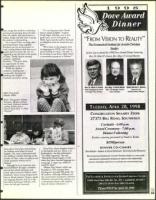
Right: First-grader
Jennifer Miller.
Below: First-graders Tatiana
Bernstein, Ma'ayan Marcus
and Justin Hayworth practice
reading Hebrew from a
Passover book titled "Is There
Chametz?"
Editor, The Michigan Catholic
Detroit Michigan
Temple Kol Ami
West Bloomfield, Michigan
TUESDAY, APRIL 28, 1998
CONGREGATION SHAAREY ZEDEK
27375 BELL ROAD, SOUTHFIELD
Cocktails - 6:00 p.m.
Award Ceremony - 7:00 p.m.
Dinner Following
Kosher catering provided by Paul G. Kohn
$150/person
them about their plays and teaching
the Hebrew word when he heard
English. The room is decorated with
the children's colorful drawings of the
Garden of Eden, other art projects and
Torah questions written out in
Hebrew.
Although he is an American who
learned Hebrew through a combina-
tion of day school education and
Israeli ulpan (intensive Hebrew class),
Kaufman, whose young charges know
him as Moreh (teacher) Aharon, speaks
the language fluently. And he is vigi-
lant about sticking to Hebrew, even
when the kids get frustrated.
Dina Kurz, whose daughter Sarah is
in third grade and son, Aaron, is in
kindergarten, was also enthusiastic.
"I'm really impressed," she said.
"Wonderful things happen to kids
when they learn a second language at a
young age. It opens up a different
world for them."
Hebrew Day School, which was
founded in 1975 and goes from
kindergarten through fifth grade, has
86 students. Although affiliated with
the Conservative movement's Solomon
Schechter network of day schools, it is
a community school, with students
from all streams of Judaism. ❑
DINNER CO-CHAIRS
Ken Kinzler • Andrea & David Liberman • Reverend John Wynnycky
The Ecumenical Institute for Jewish-Christian Studies is a non-profit
educational organization designed to improve the relationships
between Christians and Jews in a strictly non-conversionist way.
THE ECUMENICAL INSTITUTE FOR JEWISH-CHRISTIAN STUDIES
19900 West Nine Mile Rd., Ste. 205 • Southfield, Ml 48075
248-353-2434 • Fax: 248-353-6494
Please RSVP by April 20,1998
■•1110=111,