

Soul Searching
Passover marks the freedom of the Jewish people,
collectively and individually.
RENA FULKA
Special to The Jewish News
T
he weeks preceding Pesach
have been filled with prepa-
rations, from giving to
charity and reviewing the
Passover laws, to the bedikat chametz,
the final search just before the holiday
to rid the home of leavened products.
"According to biblical law, there's
not only the prohibition of eating
chametz, but even possessing it is a
prohibition," said Rabbi Elimelech
Goldberg of Young Israel of South-
field. "We very fastidiously take leaven
ut of our possession."
The ritual, commanded by Jewish
law, has been handed down through
the generations since the time of
Moses as a reminder of the haste in
which the Jews left Egypt. Today, the
act of house cleaning and kitchen
koshering associated with the journey
from bondage to freedom often takes
on symbolic tones linked with deeper
coning.
"The Talmud compares the
candle we use to search for
chametz with the candle of
God, which is the soul of
man," said Goldberg. "The
whole idea of the chametz is
that we can become lazy and
unfocused.
The entire
rocess of
Passover is
not simply a
celebration of
a historical
event. It's the
use of a his-
torical event
to recognize
at, in life,
we all become
captured or
enslaved by
our own
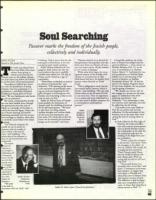
Rabbi Herbert
chains of
Yoskowitz:
Cleaning our
behavior.
souls.
"We need
to be able to
reconnect with our God," said
Goldberg. 'And to know that the ulti-
mate goal to full holiness is the tran-
scendental spirit inside ourselves."
Rabbi Herbert Yoskowitz of Con-
gregation Beth Achim says the leav-
ened products that are so carefully
whisked away before the 15th day of
Nissan can be viewed as a sign of
materialism.
"Materialism unchecked can lead to
an absence of spiritual life," said
Yoskowitz. "The cleaning of the house
is the equivalent of periodically clean-
ing our souls and preparing for the
gifts God gave us of having our own
freedom and reminding us that at one
time we were not free.
Rabbi M. Robert Syme of Temple
Israel parallels the elimination of
chametz with the shedding of spiritual
ills for self-improvement. "We need
to take from our filing cabinets
unclean thoughts and unclean deeds,
all the hurts and resentments, and
start anew. The whole idea is that the
house can be renewed just as human
beings can be renewed," said Syme.
"Passover reminds us to discard all
the grievances, the prejudices and take
them away from our libraries of mem-
ory and remove them. All the chametz
is not worthy of keeping."
While some Jews began the more
spiritual aspects of the holiday with
charity or contributions to Oak
Park-based Yad Ezra, the kosher food'
pantry, others focused on Torah
study.
"One is obligated to study the law
one month before Passover, which is
Purim," said Goldberg. "We start with
Purim when we see the hand of God
in our own lives. Then we experience
it as a nation and as an individual in a
way that won't be hidden anymore. It's
a contemplative, philosophical
process.
Rabbi
Elimelech
Goldberg:
Enslaved
by our
behavior.
Liturgically speaking, the weeks
prior to Pesach encouraged time for
spiritual reflection — from charity on
Shabbat Shekalim (Feb. 21) to the
time of remembrance on Shabbat
Zachor (March 7). And from the ritu-
al of purification on Shabbat Parah
(March 21) to the dawning of the
month of freedom on Shabbat
Hochodesh (March 28). All led the
way for the Shabbat Hagodol (April
4), the Great Sabbath, the one preced-
ing the giving of freedom.
"We cleanse our homes, but we
also engage in a process in the syna-
gogue to understand why were
cleansing our homes," said
Yoskowitz. "Our philosophy is that
you become more spiritual, not only
by reflecting, but by doing.
"God wants us to come closer to
Him by our actions and not just
reflections. It's the anniversary of our
freedom, but at the same time, we're
raising the level of coming closer to
God."
As dusk ushers in the first night of
Passover, the study and reflec-
tion will continue across genera-
tions as Jewish families around
the world gather at the table for
the traditional seder and the
retelling of the flight from slav-
ery to freedom.
"There's a place for everyone
in the service," said Syme, "from
the youngest to the oldest. As
soon as a child is old enough, he
is taught the four questions.
When Pharaoh asked Moses
who he would be taking with
him, Moses said, With our
young and our old we will wor-
ship God.'
"The overall theme is to
remember that we are free," said
Syme. "I interpret it to be more
than freedom. In Egypt, they
were slaves to Pharaoh and
when they came to Mount Sinai
they became servants of God.
The difference is that in Egypt
they were compelled to be ser-
vants. At Sinai, they were free to
choose service to God." ❑
.
Rabbi M Robert Syme: Discard the grievances;
4/10
1998
83