
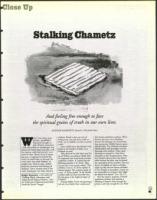

Stalking Chametz
And feeling free enough to face
the spiritual grains of truth in our own lives.
RODGER KAMENETZ Special to The Jewish News
hen I was a boy, every
Sunday, grandfather
Kamenetz brought us
gifts of food: sometimes
a sack of potatoes or cantaloupes, but
always rye bread, deep and dark, with
the caraway seeds that stuck in your
teeth for days. Bread, if you'll excuse
the pun, is ingrained in Jewish life.
Dark rye bread helps us through the
work week, but come Shabbat, it's
challah time. Rich as cake, challah
holds the sweetness and blessing of
Shabbos. Like a caraway seed in the
teeth, bread goes very deep. Bread is
W
Rodger Kamenetz is the author of
"Stalking Elijah: Adventures with
Today's Jewish Mystical Masters," win-
ner of this year's National Jewish Book
Award for Jewish Thought.
wisdom. Bread is also our way of
telling time, not only from week to
week, rye to challah, but also in yearly
cycles.
Some rabbis trace this fixation with
bread to the Garden of Eden. In a
Midrash we read:
What kind of tree did Adam and Eve
eat of? Wheat, according to Rabbi Meir.
He explained that bread made of wheat
symbolizes wisdom. R. Samuel put the
following question to R. Ze'era: 'How
can you say it was a grain wheat?' 'Nev-
ertheless it was so,' R. Ze'era replied. R.
Samuel argued: 'But scripture speaks of
a tree.' R. Ze'era replied, 'In the Garden
of Eden stalks of wheat were like trees,
for they grew to the height of cedars of
Lebanon.'
Perhaps Rabbi Ze'era was growing a
tall tale, but Rabbi Meir understood
that bread symbolizes wisdom. We've
known that ever since Abraham
learned the blessing over bread from
that mysterious Middle Eastern guru,
Melchizedek. The Midrash associates
Melchizedek with Jerusalem and his
blessings with wisdom. These same
blessings are passed in a line from
Abraham to the Temple priests. After
the Temple's destruction, the dinner
table became the altar, and the bread
the equivalent of the sacrifice. The two
loaves of challah we bless on Friday
night are like the two loaves of bread
in the Temple in Jerusalem. Loaves we
are reminded in Leviticus, that "shall
be baked with leaven" (Lev. 23: 17).
But this raises a question. If bread
represents wisdom and requires a
blessing, if bread is holy enough for
priests, and holy enough for our Shab-
4/10
1998
81