

A dazzling display of music, song,
mime, high-speed martial arts and
stunning acrobatics!
PEKING
OPERA
ONE DAY ONLY!
at the Detroit Opera House
Saturday, April 11
shows at 2pm & 8pm
For tickets and information call
TICKETMASTER
248/645-6666
or visit any TicketMaster outlet or the
Detroit Opera House box office
Mixed Media
News & Reviews.
CELLO FELLOW
Musical talents seem to have
skipped a generation in Thomas
Loewenheim's family.
The classical cellist, about to
make an encore appearance at
Temple Israel on April 5, can look
back on grandparents who also per-
formed as instrumentalists. His
grandmother was a concert pianist,
and his grandfather was a violinist
and violist.
"I like the cello because it's the
instrument most similar to the
voice," explained Loewenheim, who
will appear with pianist Christopher
Harding. "It has a big range from
low notes to high notes, and that
DETROIT
Get Results...
Advertise
in our
Entertainment
Section!
Call The Sales
Department
(248) 354-7123
Ext. 209
DETZOIT
=WM NEWS
4/3
1998
94
'TN
and Fantasia on Small Russian Songs
by David Popper.
"We wanted pieces that are quite
different but very beautiful," the
musician said.
Loewenheim, 27, a sabra who
returns to Israel every summer, has
performed throughout Israel, Europe
and the United States. He earned his
bachelor's degree in cello perfor-
mance at the Rubin Academy for
Music and Dance in Jerusalem while
serving as principal cellist in both the
Academy Symphony and the
Academy Chamber Orchestra.
A scholarship from the University
of Michigan brought him to the
United States to continue his gradu-
ate studies. After
earning his master's
degree, he went on
to attend Indiana
University School of
Music, where he is
completing work
toward a specialized
diploma.
Loewenheim also
was a member of a
chamber group that
took part in the
Gilmore
International
Keyboard Festival in
Kalamazoo, where
he worked with Yo
Yo Ma and Emanuel
Ax in 1996.
— Suzanne Chessler
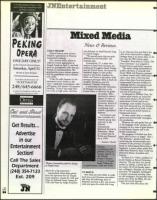
Thomas Loewenheim performs Sunday
at Temple Israel.
allows for a big repertoire."
Loewenheim chose three pieces
from his repertoire for his Temple
Israel audience: Sonata for Cello and
Piano by Edward Grieg, Sonata for
Cello and Piano by Sergei Prokofiev
TV WATCH
Few items are more likely to make
both Jews and Christians uncomfort-
able than the following: Jesus of
Nazareth was born a Jew, was circum-
cised and spent his whole life living
as an observant Jew and died a Jew
who never renounced his religion.
Perhaps there is no irony, then, in the
fact that the PBS 4-hour series
"Frontline: From Jesus to Christ: The
First Christians" is so steeped in
Jewish history and Jewish concerns.
The series, airing nationwide on
public television to coincide with
Easter Week and Passover, attempts
to whisk viewers back 2,000 years to 9(
take a close look at the time and
place where Jesus lived and present
controversial historical evidence to
challenge familiar assumptions and
conventional notions held by
Christians and Jews about the origins
and rise of Christianity.
As directed by William Cran, the
camera relies heavily on interviews
with noted scholars of both faiths,
aerial views of Israel and its sur-
roundings, scale models of ancient
sites now destroyed (e.g. the Temple)
and a few works of art, with a num-
ber of traditional Jewish hymns as
background music.
In other words, this is a visually
sparse and cinematically unimagina-
tive production.
However, the real sparks here are C=(
in the language of the scholars who
transport us to a time of great foment
in the Roman Empire and in the
Jewish community.
The program is divided into four
parts, each an hour in length. Part 1,
"Pax Romana," spends much time
examining the socioeconomic envi-
ronment of the province of Galilee
based on archeological discoveries at -> <
Sepphoris, a major urban center four
miles from Nazareth. Jesus' world was
defined by Rome, Jerusalem and
Judaism.
As Shaye J.D. Cohen, professor of
Jewish Studies at Brown University,
observes: "He was born of a Jewish
mother in Galilee, a Jewish part of
the world. All of his friends, associ-
ates, colleagues, disciples, all of them
were Jews. He regularly worshipped
in Jewish communal worship, what
we call synagogue. He preached from
Jewish text, from the Bible. He cele-
brated the Jewish festivals."
This part ends after Jesus cele-