
s>
tip.
11",)r ehail tit .
mdlest
AtkAiMb
NO. 1 AGAIN
IN BUICK SALES!
45 Years in Business and
We're Still Developing.
phorogRAphy
Metro Detroit's Longest Standing
Family-owned Studio.
•Superior Quality • Competitively Priced
•State-of-the-art Thehniques
32731 Franklin Rd. • Franklin, MI • 48025
(248) 626-3666
MIR= -
JEWISH NEWS
4/3
1998
84
CLASSIFIEDS
GET
RESULTS!
Call
(248)354.5959
Organization.
In the early 1980s, its long-time
leader, the now-deceased Heinz Gal-
inzki, declared that Jewish day
schools must be established. And so
they were.
Since 1986, four Jewish day
schools have sprung up in Berlin,
Dusseldorf, Frankfurt and Munich.
As one example, the 12-year-old Gal-
inzki Elementary School has two
branches with a total of 400-plus
students in grades one through six.
One of its sites is a multimillion-dol-
lar structure with a full gymnasium,
separate dining hall, auditorium,
computer, art and music rooms.
And, bound to be the envy of
American Jews, tuition ranges from
$30 to $225 per month, depending
upon family income and the number
of children in school. The school's
religious ideology is described as
traditional and more than half the
students come from the former Sovi-
et Union.
Here, if one is not Jewish according
to Jewish law — meaning that the
mother is Jewish — one can still
attend a Jewish day school. The
Gemeinde's executive committee
recently decided that while Jewish
children should be favored in applica-
tions and matriculation, others can be
admitted when there aren't enough
Jewish students to fill the classes.
Surprisingly, more than two-
thirds of the 45 teachers are not
Jewish. Even the co-headmaster of
the city's 220-student Jewish high
school is a non-Jew. He confided to
me that he enjoyed working in a
Jewish school because there was a
"sense of family."
Unique to these day schools is not
if, but how the Holocaust should be
taught. Yet, the personal experiences
of parents and grandparents often
interfere with a willingness to encour-
age in-depth study. But for Jews and
non-Jews alike, the Holocaust and
Nazi era cannot be avoided.
While day school education is
expanding, signs of assimilation are
apparent; a significant number of
community leaders send their chil-
dren to established non-Jewish pri-
vate schools with their more notable
secular reputation. And in many of
those places, Jews are welcomed.
As one American Jewish educator
working here told me, "Jews are •
icons. Anything Jewish is worshiped
in Germany. The guilt feeling still
runs high."
It's not exactly what Hitler or
Goebbels had in mind.
❑
Dr. Kenneth W. Stein, the son of
German Jewish immigrants, is a pro-
fessor of Near Eastern History and
Political Science at Emory University
in Atlanta. His mother, Mathilda
Wertheim Stein, just completed a 600-
page book manuscript titled "The Way
it Was," recollections of family and
Jewish social history in the Germany
she knew.
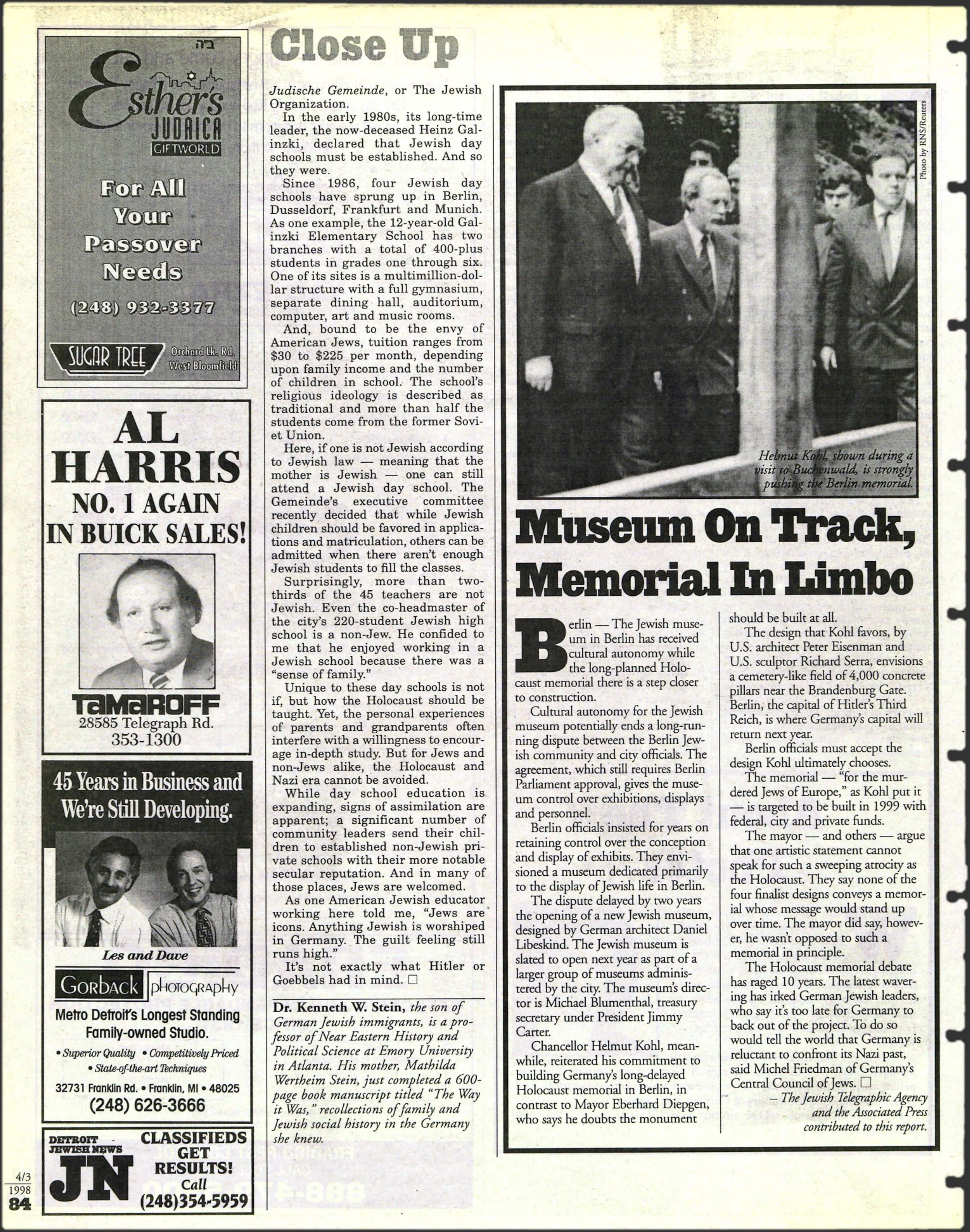
Pho to by RN S/Reu ters
Judische Gemeinde, or The Jewish
Museum On Track,
Memorial In Limbo
B
erlin — The Jewish muse-
urn in Berlin has received
cultural autonomy while
the long-planned Holo-
caust memorial there is a step closer
to construction.
Cultural autonomy for the Jewish
museum potentially ends a long-run-
ning dispute between the Berlin Jew-
ish community and city officials. The
agreement, which still requires Berlin
Parliament approval, gives the muse-
urn control over exhibitions, displays
and personnel.
Berlin officials insisted for years on
retaining control over the conception
and display of exhibits. They envi-
sioned a museum dedicated primarily
to the display of Jewish life in Berlin.
The dispute delayed by two years
the opening of a new Jewish museum,
designed by German architect Daniel
Libeskind. The Jewish museum is
slated to open next year as part of a
larger group of museums adminis-
tered by the city. The museum's direc-
tor is Michael Blumenthal, treasury
secretary under President Jimmy
Carter.
Chancellor Helmut Kohl, mean-
while, reiterated his commitment to
building Germany's long-delayed
Holocaust memorial in Berlin, in
contrast to Mayor Eberhard Diepgen,
who says he doubts the monument
should be built at all.
The design that Kohl favors, by
U.S. architect Peter Eisenman and
U.S. sculptor Richard Serra, envisions
a cemetery-like field of 4,000 concrete
pillars near the Brandenburg Gate.
Berlin, the capital of Hider's Third
Reich, is where Germany's capital will
return next year.
Berlin officials must accept the
design Kohl ultimately chooses.
The memorial — "for the mur-
dered Jews of Europe," as Kohl put it
— is targeted to be built in 1999 with
federal, city and private funds.
The mayor — and others — argue
that one artistic statement cannot
speak for such a sweeping atrocity as
the Holocaust. They say none of the
four finalist designs conveys a memor-
ial whose message would stand up
over time. The mayor did say, howev-
er, he wasn't opposed to such a
memorial in principle.
The Holocaust memorial debate
has raged 10 years. The latest waver-
ing has irked German Jewish leaders,
who say it's too late for Germany to
back out of the project. To do so
would tell the world that Germany is
reluctant to confront its Nazi past,
said Michel Friedman of Germany's
Central Council of Jews.
— The Jewish Telegraphic Agency
and the Associated Press
contributed to this report.
❑