

CeleBraTe
Books 0 The
1 Gemara, which literally means "corn-
I pletion." It is commentary on the
Mishna.
Chumash
The Chumash is another name for the
Five Books of Moses. It is related to
chamesh, the Hebrew word for five.
It refers specifically'to the book
you'll ,find in your synagogue or tem-
ple and usually includes both
Hebrew and English, so you can foi-
1 low along as the Torah reader recites
the parsha, or portion of the week.
Sicdur
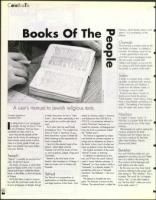
A user's manual to Jewish re 9 tous texts.
Elizabeth Applebaum
AppleTree Editor
I
t's sitting there in your synagogue
or temple. Its big. It's heavy. It has
a lot of Hebrew. And you have
absolutely no idea what it is.
Jews may be the people of the
book, but for many it's confusing to
know exactly which book is which.
Here is a handy guide to help you
learn your Tanach from your Siddur
from your Talmud.
Tanach
"Tanach" is actually an acronym for T
orah, N evi'im,K etuvim.
The Torah, of course, is what God
gave to Moses at Mt. Sinai. In some
places you'll see it called the Penta-
teuch, or the Bible, or the Five Books
of Moses.
You'll also hear it used in conjunc-
tion with the scroll kept inside the ark
at your synagogue or temple, though
3/13
1998
66
a better description for this is "Sefer
Torah," which refers specifically to the
text copied by a scribe onto parch-
ment.
You'll often hear the word Torah
translated as "law." The correct trans-
lation of Torah is "teaching." If you
think about that, it gives a whole dif-
ferent meaning to the importance of
Torah in Jewish life.
Nevi'im is the second book of the
Tanach, which deals with the
Prophets and with the books of histo-
ry, such as Joshua, Judges, Kings and
Chronicles.
Ketuvim is the third book of the
Tanach, also translated as Writings. It
refers to books such as Psalms and
Proverbs.
Talmud
The Talmud is a compendium of
explanations on both the narrative
and legal portions of the Torah. Corn-
pleted by leading rabbis in Palestine
and Babylonia from 500 BCE to
500 CE, it is sometimes referred to
as the "Oral Law" because it is
based on centuries of dialogue (simi-
larly, the Torah is sometimes called
the "Written Law").
The Talmud is regarded by obser-
vant families as divinely inspired; its
rulings are as obligatory as those in
the Torah. In fact, much of what we
know as Judaism is from the Talmud.
The English translation of the word
"talmud" is study, or learning.
In addition to references to the
text, you'll hear the word "talmud"
used in many Hebrew phrases. A
"talmeed" is a boy student, while a
"talmeeda" is a female student. If
somebody calls you a "talmeed
chacham," be flattered — this is a
scholar.
The Talmud is divided into two
parts. The first part is known as the
Mishna. The second part is called the
A Siddur is a prayer book, contain-
ing either, or perhaps both, services
for the week day and Shabbat. It
comes from the Hebrew l'seder, or
"to arrange, to put in order."
If you've ever been in Israel, no
doubt you've heard the phrase,
"hakol b'seder," which means, "Every-
thing is okay [literally: everything is in
order]." The retelling of the Passover
story, the seder, also means "order."
Machzor
In English it means "cycle." A
Machzor is a prayer book that coh-
tains services for any of the major
holidays.
Most people are used to seeing the
machzor printed for the Rosh
Hashana and Yom Kippur, but you
can find a machzor for the three
other major holidays: Pesach,
Shavuot and Sukkot.
Bentsher
You won't find this inside your con-
gregation's sanctuary, but you'll likely
see it at a table in the dining hall.
This contains all the blessings said
both before and after meals.
By the way, you may have heard
someone referring to the prayer said
after eating as "The HaMotzi." This is
incorrect. The word "ha" in Hebrew
means "the," so you don't need to
say "the the Motzi" unless you want
to be really weird. ❑