

P hoto by G lenn Tr ies t
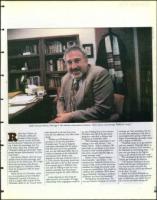
Rabbi Norman Roman: Marriage is "the ultimate consecration of existence. That's why we call marriage 7eiddushin' (holy)."
abbi Alon Tolwin, an
Orthodox rabbi and
founder of the Detroit
branch of Aish HaTorah,
says his divorces "enhanced my teach-
ing. I don't do counseling, but I've
been there, done that. People said,
`Orthodox rabbis get divorced?' Some
people became disenchanted, but they
came back."
Last winter, Tolwin, who has seven
children from his first marriage, tied
the knot for the third time. He is right
about the perception that divorce
doesn't happen to Orthodox rabbis;
that's the perspective held by many
individuals.
Rabbi Steven M. Dworken, execu-
tive vice-president of the Orthodox
Rabbinical Council of America, as
well as a pdlpit rabbi, knows of two
Orthodox rabbis in the United States
who divorced in the last four years.
One left the rabbinate, the other made
aliyah.
"Within our [Orthodox] con-
stituency, it is not very prevalent,"
Dworken says. "It just so happens
both these individuals left the pulpit.
Did they have to? In one particular
case, no, the individual didn't have to.
I think it depends on the individual's
community, and I think it also
depends on the type of divorce that it
is. If the divorce was pretty much ami-
cable and [there was] no 'dirt' around,
if two people grew in different man-
ners and are willing to part in a very
positive, amicable way, that doesn't
necessarily impede the rabbi's efficien-
cy. ,,
It also depends on how long the
rabbi has been at his pulpit. A longer
relationship with congregants could be
an asset holding him to his contract,
Dworken says. But if he goes shop-
ping for a new shul, a divorce may
handicap an Orthodox rabbi.
"The Orthodox community is not
willing to live with divorce," says
Rabbi Tolwin. "Life is a balance. We
don't hide our problems in the closet.
It's bad to hide marital problems in
the closet; [couples should] fight to
make marriage work."
Today's society "accepts divorce —
that's horrible," says Tolwin. "The
standard that Halachah (Jewish law) is
trying to help us rise to has much less
tolerance for things the secular world
accepts as standard fare. Get people to
confront their problems. We're listen-
ing to Halachah, learning to confront
problems, not lower our standards."
Having been divorced twice, Tol-
win says halachic demands of a Jewish
marriage are "not unrealistic, but it's
not easy. But anything in life that is
meaningful and is going to have any
degree of permanence generally comes
with a degree of difficulty.
"Halachah wants us to get married
and stay married. Halachah allows us
the option of divorce if it's necessary.
So Halachah is interlocking steps — if
you can't get along on the highest
rung, so get along on the next rung."
The teachings of Jewish law helped
Tolwin get through his divorces.
"The human tendency is to just
strike back because striking back is
one way we mask our pain, but
Halachah says no, you're not allowed
to do that," he says.
Rabbi Tzvi Hersh Weinreb, an
Orthodox pulpit rabbi and psycholo-
gist in Baltimore, says while divorce
may not be prevalent among the
3/6
19