

A Grandma's
Laughter
A granddaughter reflects on a life
with a complicated but loving woman.
JULIE EDGAR
News Editor
t just under five feet, I am
finally taller than my grand-
ma, even counting her high
beauty shop hair. I noticed
the change a few years ago.
I've noticed many things about my
grandma lately that escaped my atten-
tion for so many years, like she has a
difficult time letting go of ancient
slights and she can be moody. Nat-
urally, it's not easy getting a good
meal.
Perhaps growing older strips
away illusions about ourselves
and others as the fact of our
mortality insinuates itself.
Maybe my grandma has gotten
crankier with the passing years.
More likely, her idiosyncracies
never really registered because
they were so much less important
than what I learned about love
from her.
I consider myself truly fortunate
to have grown up with another set of
parents, the kind who loved us
unconditionally and didn't place
demands on us.
Spending time with them was never
a burden, never an activity I dreaded.
Every Shabbat we'd go to their home
on Lauder in Detroit, a place steeped
in the heady aromas of chicken soup,
brisket and cigar smoke. The smells in
that house were the kind that smoth-
ered you in their goodness, just like
my grandma, whose hands were
mushy, I guessed, from kneading
dough for her kreplach. Daisy, their
beloved wired-hair terrier, maniacally
ran loops around the furniture when
we came in. My grandma always
stocked the fridge with chocolate,
notably the white chocolate Scottie
A
Julie Edgar is News Editor of the Jew-
ish News.
2/27
1998
90
dogs with the tartan collars. We took
turns biting off the end of my papa's
cigars and lighting them. We fought
over who would sit in their garish
recliner. We watched the Beatles on
Photo 6),
krrsr
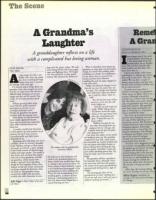
The author with her grandmother,
Genevieve Glicker.
Ed Sullivan in their bedroom and
tried on my grandma's glamorous
shoes, which were stacked from floor
to ceiling in her cavernous closet. I'd
always pause in their bedroom to gaze
at the hand-tinted photograph of my
grandparents on their wedding day.
There she was, breathtaking in her
wedding gown, a column of satin
forming a shimmering pool at her
feet, her auburn hair shaped into a
marcel framing her face.
What I remember most about my
grandma in those days was her hearty
laugh, her hands that couldn't resist
pinching our cheeks, her indifference
to the havoc that we raised in her
home, and the often hilarious
needling she and my papa engaged in
with each other.
Today I see physical changes in her
that jolt me into the reality that she
has aged. Her eyesight and hearing
have faded and, when she allows
me, I hold her elbow while we
walk.
But she has lost none of her
memory or wit, and she still
never judges me.
And she can still make me
laugh. While talking about
the dinner served the night
before at her apartment com-
plex, she contemptuously
spat, "I don't like cats, let
alone catfish."
Walking through the air-
port after returning from my
nephew's brit in Chicago, she
casually observed that the pilot
was "going too fast."
Last week, the subject of my moth-
er's wedding came up. My grandma
recalled how they had a dress made,
how beautiful my mother looked, and
the two guests who didn't bother to
show, leaving them holding the bag
for two plates. Grandma, I said, you
can't still be thinking about that. Up
from her belly came that throaty
laugh.
My grandma still has a penchant
for beautiful shoes, although I have
my own now. And now she pinches
the cheeks of her great-grandchildren,
unconsciously letting loose a sigh of
delight.
The photograph taken of my
grandparents on their wedding day —
it's on my wall now. I still can't pass it
without catching my breath. ❑
Remei
A Gran
ALLISON KAPLAN
Special to The Jewish News
was always one of the other
grandchildren. Growing up
a few states away from my
grandmother, as my brother
and I did, my first cousins who
lived nearby were her kids. And
then there was us.
I know she didn't really mean
anything by it, calling my cousins
hers, and us the other. That was
reality. We saw her a couple of
times a year at best, and they had
her for every birthday, holiday and
all the days between.
So three years ago when I
moved to Chicago, my grandma's
home town, we didn't really have a
routine. Although remarkably
healthy for a woman well into her
80s (she didn't even need a hearing -
aid), my grandma's legs were crip-
pled with arthritis. Her painfully
slow limp made strolling by the
lake or browsing in a department
store a prohibitive chore.
But stick my grandma behind a
grocery store shopping cart, and
she was off like lightning. Com-
paratively, anyway. We developed a
Sunday afternoon habit of grocery
shopping together, following a
leisurely lunch at one of her two
favorite restaurants, The Whistler
or Barnum and Bagel, where the
age of the clientele averages
around 110 and the chefs have
never heard from low-fat.
The first time I suggested we go
see a movie, my grandma told me<
she doesn't go to movies. To which
I replied, who doesn't go to
movies? Being that I was the only
licensed driver between us, I put
her in the car and headed for the
theater, letting her ramble the
whole way about how she doesn't
like movies or being out after
dark.
After that, she started calling "--/
me most Tuesdays to tell me which
I
,
Allison Kaplan contributes fre:-
quently to The Scene from her home
in Chicago.
t, *** :46*. ,,,,,t:fitibAtAilxiiv