

Israel — Aronson drafted a memo re-
examining the traditional structure for
North American giving to Israel. His
conclusions: "The national 'system'
today is, in a real sense, a series of
competing interests which are not
providing creative and unified leader-
ship to federations as they struggle to
redefine their relationships with
Israel."
To alter the situation, Aronson has
proposed — among other things —
that federations directly nominate del-
egates to the JAFI board, that the
overlapping Israel-related functions of
the United Israel Appeal, Council of
Jewish Federations (CJF) and UJA be
merged and that the Jewish Agency be
the "primary, but no longer the exclu-
sive agent of UTA, for federation
funding in Israel."
Aronson's proposals were unani-
mously approved earlier this month at
meetings with federation leaders and
have been recommended to the execu-
tive committee of the UTA.
Currently, United States delegates
to the JAFI board are selected by the
UJA, multiple professionals and
boards have overlapping responsibili-
ties in Israel-related decisions, and
federations that want to stay in the
system must work exclusively with the
Jewish Agency when developing pro-
jects in Israel.
"The premise of my paper is that
we're still better off acting collectively,
but we have to have a national and
international system that's responsive,"
said Aronson, who hopes the changes
he's suggested will lessen the "discon-
nect" between federations and the
side of the UJA's scope.
agencies that spend their money over-
The changes in the federation-UJA
seas.
relationship are occurring against a
"Federations don't feel they've been
backdrop in which a growing number
able to establish direct relationships
of gifts to Israel bypass the federation
with Israel and agencies overseas, and
system altogether, instead of going
often decisions made by the UTA or
directly to Israeli institutions, such as
JAFI
boards are not communicated
universities and hospitals.
directly back to federations
Amidst this climate of transi-
and not necessarily sup-
tion, Bob Aronson, executive
Bob Aronson:
ported by federations," said
vice president of the Jewish
Wants federations
Aronson.
Federation of Metropolitan
to play a greater
Conflicts have emerged
Detroit, is emerging as a
role in funding
national voice of moderation,
decisions overseas. recently over how funds are
spent in Israel, he said,
someone who wants to reform
adding that many North
— but not dispense with —
American federations feel that projects
the traditional federation-UJA rela-
like Partnership 2000 are not high
tionship.
enough priorities of JAFI and the
Aronson has proposed national
UTA. Partnership 2000 is a 3 - year - old
changes that he hopes will preserve
program whereby Diaspora Jewish
faith in "the system" by making it
communities are partnered with Israeli
more accountable to local federations.
communities in order to facilitate
At the request of the United Israel
joint projects and information sharing
Appeal (UTA) — the conduit through
at a grassroots level.
which the UJA transfers funds to
Although Aronson has been critical,
Chtnging
'S stem'
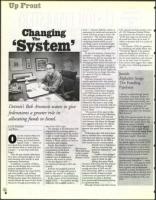
Detroit's Bob Aronson wants to give
federations a greater role in
allocating funds to Israel.
JULIE WIENER
Staff Writer
0
nce the central address for
American Jewish philan-
thropy, the United Jewish
Appeal (UJA) — which col-
lects funds from Jewish federations
and allocates them to Israel and Jews
overseas — is now beset with chal-
lenges.
Over the past decade, federations
have been cutting their gifts to UJA
and investing more heavily in local
community institutions.
In addition, a number of federa-
tions are developing their own Israel
projects independent of the
UJA/Jewish Agency for Israel (JAFI),
and some leaders, such as Barry
Shrage of Boston's Combined Jewish
Philanthropies, argue that federations
should allocate far more of their Israel
donations through partnerships out-
2/27
1998
8
UJA response has been positive over-
all. UJA Chairman Richard Wexler
was quoted in the Forward as saying,
"If this had come out previously, we
all would have seen up in arms. It
reflects a situation that is in a state of
transition."
Gail Hyman, UJA's vice president
for marketing and public affairs said,
"The Jewish Agency is the primary
agent for distribution of dollars in
Israel and is likely to remain that — it
has the most experience and expertise.
But we do share some of Aronson's
basic notions that suggest there might
be other ways of funding programs as
well." ❑
Jewish
Alphabet Soup:
The Funding
Pipelines
• Money is raised through Jewish
federations. Federation leaders in
each community then decide what
percentage will remain locally and
what percentage goes to the United
Jewish Appeal. (In Detroit, the
breakdown is roughly 50-50, says
Federation Executive Vice President
b Aronson)
The UJA removes money for over-
ead costs and new immigrant ser-
vices within the United States. The
maung
li money is i divided
between the United Israel A
(UM), which gets roughly 8
'
cent, and the Americani
Distribution Committee (JDC),
which gets roughly 20 percent.
.
e UIA. funds are transferred to
e Jewish Agency for Israel (JAN),
which then allocates the money to
cies and projects within Israel.
DC funds go toward humani-
tarian initiatives around the world,
including some projects in Israel.
Should Aronson's suggestions be
implemented., federations — rather
than the MA -- will appoint mem-
bers to the JAFI board and thus
have a greater role in allocations
decisions in Israel. In addition, fed-
era.d.ons will be able to develop their
own funding projects overseas with
other players besides the JDC and
JAFI.