

0
0
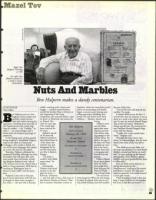
Right: Ben
Halpern: Thriving
at 100.
Far right: Ben
Halpern's passport is
a study in multi-
nationalism.
ttAkk:s .
Nuts And Marbles
Ben Halpern makes a dandy centenarian.
JULIE EDGAR
News Editor
B
en Halpern puts on a her-
ringbone dinner jacket and
carefully combs his fine
white hair before leaving his
apartment. Strolling down the halls of
the Heatherwood with a little help
from his walker — his "Cadillac," he
calls it — he acknowledges with a
broad smile the frequent greetings of
passers-by.
In the dining room of this assisted
living complex in Southfield, Halpern
stops at the table of a friend and
exchanges a few words in Polish. It's
one of the seven languages he's picked
up in his 100 years on the planet.
Yesterday, Halpern celebrated his
centennial birthday, although not with
the fanfare that will greet him early
next month when his family, includ-
ing daughter Barbara Levin, wife of
U.S. Senator Carl Levin, throws him a
bash at a local restaurant. He'll also be
traveling to Washington later in
March to have coffee with the presi-
dent.
Halpern is not tied to the past,
but if you're interested, he'll tell you
he fought in three wars, escaped a
few times — the last with a Russian
'
soldier running with a horse and
buggy — crossed several borders,
joined his brother Max in Detroit at
the beginning of the Great
Depression and married Esther, a girl
he knew in Bialystok, his hometown
in Poland. She
died six years ago.
The couple had
been married for
65 years.
Halpern was all
of 30 years old
when he arrived in
the United States in
1928, alone, bat-
tered by war and
denigrated by his
second-class status
as a Jew in Eastern
Europe.
"I'm lucky. I
could've been killed
many times," he
admits.
Fortunately,
Halpern had saved
money in the last
place he lived —
Kalvaria, Lithuania
— and was able to buy a fish store in
the Eastern Market in Detroit. That
led to another wholesale venture in
Ypsilanti, where he earned his certifi-
cation in accounting, and finally
began a second career buying and
selling apartment buildings and
hotels. He and Esther bore three
children — Barbara, Daniel and
Irving.
Halpern never
saw his father
again after meet-
ing him one last
time before mak-
ing passage to the
United States. He
died at the age of
84 when the Nazis
rounded up every
Jew in his town,
herded them into
a synagogue and
burned it to the
ground.
Halpern figures
he got good genes
from his father,
who might have
lived long past 84.
Then he breaks
into a broad smile.
The real secret
of his longevity? When he was young,
he jokes, he played with nuts on cer-
tain Jewish holidays and with marbles
the rest of the time.
"I ate all the nuts and kept all my
marbles," he quips.
A shadow fleets across his face. It
worries him that his memory is not as
sharp as it used to be; about two years
ago, he says, he noticed himself forget-
ting words and names. Alzheimer's
disease spooks him. He mentions for-
mer President Ronald Reagan's diag-
nosis with the disease.
"I really start to get scared some-
times," Halpern says.
Through the years there were
times, he acknowledges, that he won-
dered what kind of joy was left to
him.
"You think as you get older, you
don't get any pleasure, but then there's
children around and they're so much
fun," he says, picking up the framed
photographs of his children, grand-
children and great-grandchildren from
a coffee table.
And, he finds much pleasure in
sitting downstairs at the
Heatherwood, looking at the woods
and flowers outside. He also plays
cards occasionally and strolls around
a local golf course.
"I feel thankful to God to live that
long. I hope He'll let me live another
few years. I like life, you know?" ❑
2/27
1998
61