

The. World
ICC 1997-1998
Encore and Chajes
Concert Series
presents:
A light classical concert with
ty6-1, Snexrnide
glie 0- et/tat
J
Ordieedrw
played a leading role in the creation of
the Leadership Conference on Civil
Rights in 1950.
Aronson was also secretary of the
National Emergency Civil Rights
Mobilization, the group organized to
support President Truman's controver-
sial civil rights program.
Aronson began his civil rights
career in 1941 as head of a group
fighting job discrimination against
Jews; he quickly decided to expand his
focus to all forms of employment dis-
crimination, and formed the Chicago
Council Against Religious and Racial
Discrimination, a prototype civil
rights organization.
Aronson also played significant
roles in the passage of several land-
mark civil rights laws, including the
Civil Rights Act of 1964 and the Vot-
ing Rights Act of 1965.
"If you were going to name two or
three outstanding Jewish profession-
als over the past generation, he
would lead the list," said Hyman
Bookbinder, the former Washington
representative of the American Jew-
ish Committee. "He did much to
keep the Jewish community actively
loyal to our commitment to civil
rights. Like others, he grieved over
the rift that developed between
blacks and Jews, but he always main-
tained that the alliance was not as
broken as people were alleging. His
death is a great loss to our communi-
ty.
”
resident Clinton sounded
more like a candidate than a
lame duck in a major
address to the National
Council of Jewish Women.
In a long and rambling speech,
Clinton covered a wide range of
social and health initiatives he plans
to promote during the remainder of
his term, and expressed satisfaction
that the latest confrontation with
Iraq had ended without military
action.
"As you know, yesterday the gov-
ernment of Iraq agreed to give the
United Nations inspectors immediate,
unrestricted and unconditional access
to any site they suspect may be hiding
weapons of mass destruction or the
means to make or deliver them," he
said. "If fully implemented, this means
that, finally, and for the first time in
seven years, all of Iraq will be open to
U.N. inspections, including many
sites previously declared off-limits.
This would be an important step for-
ward."
He said that "once again we have
seen that diplomacy backed by resolve
and strength can have positive results
for humanity," but he warned against
complacency now that the crisis seems
to be over: "We have to be watching
very closely now to see not just what
Iraq says, but what it does; not just
stated commitments, but the actual
compliance."
And he urged NCJW members to
"launch an effort to educate all the
people of our country about the
Pho to by A IVI. ;wo n App lewlme
Clinton Addresses
NCJW
1p
Sunday, March 8, 1998
2:00 p.m.
Jewish Community Center
Maple/Drake Building •
Tickets:
$10 for members • $15 for non-members
For tickets and information call:
(248) 661-7649 Maple/Drake
or
(248) 967-4030 Oak Park
CC
,
Funded in part by the Manny and Natalie Charach Endowment for
the Cultural Arts, the Irwin and Sadie Cohn Fund, the DeRoy
Testamentary Foundations and the Boaz Siegel Culture Fund.
2/27
1998
44
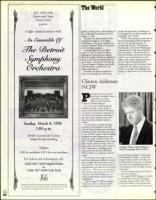
President Clinton urged lobbying on
behalf of campaign finance reform.
potential future dangers of chemical
and biological warfare — how such
weapons can be made, how they can
be delivered, how easy it is to dissemi-
nate them to irresponsible groups in
small quantities that do large amounts
of damage."
But the primary focus of Clinton's
speech was domestic.
He urged NCJW delegates to lobby
on behalf of the McCain-Feingold
campaign finance reform bill, which
was up for debate in the Senate later
in the day, and repeated his insistence