
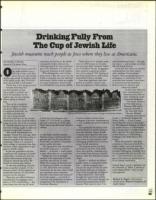

Jewish museums reach people as Jews where they live as Americans.
RICHARD A SIEGEL
Special to The Jewish News
0
experience are not lost to the Jewish
community. In fact, they are con-
tributing some of the most vital ener-
gies to the definition of a vital, con
temporary, American Jewish culture
What distinguishes each of these
phenomena is that they cross over the
Jewish community into the American
mainstream. Jewish studies are taught
in secular universities. Jewish books
are published by commercial publish
ne of my friends makes Fri-
day night kiddush over a
full cup of wine, and then
pours the wine into several
smaller cups which he hands to each
of the guests at the table. Is his kid-
dush cup half full or half empty?
Clearly that is the wrong question
— because each drop that
has been poured out has
been caught in another ves-
sel. If we only focus on the
leader's cup, we can ovedook
what is going on around
him.
This can be a metaphor
for the condition of Ameri-
%1%* 108-twaft,
can Jewry: When we look
at organized Jewish life, we
can easily conclude that
the cup is being drained.
But if we only focus on the central
institutions, we may overlook what's
going on in the rest of the communi-
ty. I would contend that far more of
• our wine is being caught in other ves-
sels than we generally recognize.
Take Jewish scholarship as an
ers an ti ~ mi
example. T-wenty-five years ago, there
Klezmer id
were three chairs of Jewish studies in
glewood and The Knitting Factory
America outside of the rabbinical
Jewish films are shown at Sun dae
seminaries. Today, it is unusual to
and on public television.
find a college or <university that does
The opportunity that this presents
not have a chair, department or pro-
the Jewish community is unprece-
gram in Jewish studies.
dented — to be able to reach people
In just one generation, we have
as Jews where they live as Americans.
transformed the landscape of Jewish
Perhaps the most remarkable
scholarship in America to rival the
example is the experience of Jewish
highest achievements of pre-war
museums over the last 25 years.
Europe or present-day Israel. We
When the Council of American Jew-
should be amazed and exultant.
ish Museums (CAJM) was founded.
Or take the publishing of Jewish
in 1976; there were seven member
books as another example. Or the
institutions. At the time, that in itself
klezmer revival. Or the explosion of
was impressive; seven museums
Jewish film festivals. Or the Jewish
devoted to the history and culture of
presence on the Internet.
the Jewish people — on a level of
These may not reflect federation
curatorial and professional excellence
Contributions or synagogue atten-
recognized by the Association of
dance, or JCC memberships — but
American
Museums.
these drops from the cup of Jewish
Today, there are 57 member muse-
ums in CAJM located in 24 states
and provinces from Northern Califor-
nia to Southern Florida. In aggregate,
they represent 'a significant propor-
tion of our cultural GNP, putting on
hundreds of exhibitions and hosting
thousands of visitors annually.
Even more significant than their
growth in numbers, however, has
been the expansion of their mission.
"
14. 100*
most fundamental ways through
the object — and its place in Jewish
life and Jewish history.
In the past five years, yet another
transformation has been taking
place, perhaps of even greater
import. Once primarily adjuncts to
synagogues or seminaries, Jewish
museums have become a new breed
of Arrierica.n Jewish institution ---
both at home in America and
assertively Jewish.
In this, they reflect the
new consciousness of
American Jewry like no
other institution in the
communal landscape.
The Jewish Museum
in New York sits on
Museum Mile and is
regularly reviewed in
the New York Times.
es
The new Skirball
tiseum and Cultural
e,signed by
e,
erice
instil
tions, t
of activi
mances,
classes.
Quietly without any demo-
graphic study or communal resolu-
tion — Jewish museums have
become the major forums for infor-
mal Jewish education in America.
They teach through the intelligence
of their exhibitions. They teach
through the interactivity of their
installations. They teach through the
stories and commentaries of their
docents. They teach in one of the
of the Jewish cornititi
Richard Siegel's article is reprinted with
the permission of "Shana: A Journal of
Jewish Responsibility" where it origi-
nally appeared,
Richard A, Siegel is the executive
director of the National Foundation
Jewish Culture.
2/20
1998
95