

The BiG StorY
c—;
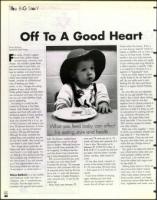
Off To A Good Heart
Diane Baldwin
AppleTree Staff Writer
F
ish sticks, chicken nuggets,
french fries, grilled cheese,
canned soups, macaroni and
cheese. You wouldn't puree these
and feed them to your baby, yet
they are fast becoming standard
fare for toddlers and preschoolers.
If you are concerned about your
child's future eating habits and
health, consider an old-fashioned
way of feeding your baby —
which, in turn, changes the eating
patterns of your whole family.
While grilled cheese and fish sticks
are convenient and tasty, with prac-
tice you can make healthier foods
just as appealing.
According to a study by the
Centre for Science in the Public
Interest, both Gerber and Heinz
replace real food with water and
thickening agents in many products
for children over 6 months. The
study also showed that a 4 oz. jar
of Heinz bananas with tapioca con-
tains 30 percent bananas. A home-
made, 4 oz. serving of bananas
contains 100 percent bananas.
Although the study revealed that
added flours and modified starches
do not harm health, why would you
want these in your baby's food?
Don't forget about pesticides, fer-
tilizers and other non-food contami-
nants found in our food supply. It is
not difficult to find quality foods like
fresh produce and whole foods in
the Detroit area. If you ask around,
you'll find opportunities to join a
food co-op where you can pur-
chase organic or whole foods in
Diane Baldwin is a new mother
and freelance writer who lives in
Clarkston. Her 1 1 month-old son,
Nicholas' favorite baby food is
meatloaf with spinach and carrots.
2/13
1998
68
bulk. The farmers markets have
amazingly low prices on all pro-
duce in season. Although local pro-
duce can still have pesticides (if it
isn't organic), it's likely to be less
and they haven't lost nutrients dur-
ing a long transportation process.
Still not convinced that you want
to make your own baby food?
Consider the savings. The average
American child consumes 600 jars
of prepared baby food by the time
he or she is 1 year old. Compare
this to babies in Eastern European,
who consume only 12 jars by the
same age.
Baby food costs between 39
cents and 78 cents per jar. A 10-
month- old baby eats upwards of 4-
5 jars a day. That works out to
between $1.95-$3.90 a day, or
$58.50-$1 17 a month for one hun-
gry baby. And this doesn't include
cereal, crackers, other snacks or
juices.
On the other hand, a bunch of
carrots at the farmers market costs
$1.25 and makes 28 food cubes
— that's equal to 9.3 small jars of
carrots.
If you have children at varying
ages, making your own food
allows you to prepare meals or
snacks that all of them can eat.
c=(
Simply adjust the texture. There is
no more buying "special" foods for
babies or toddlers and no more run--,
ning out of those foods. Another
benefit is that your baby becomes
accustomed to the tastes and smells
of your cooking style long before he
is able to express it verbally. There
is no need for a transition to or a
rejection of "big-people" food.
Once your baby begins to want
chunky foods so he can feed him-
self, do you really want to start
feeding him fish sticks and french
fries on a regular basis? Probably
not.
So, now that you are interested,
how do you get started? First, you
need to buy a book about making
baby food. Look for one that
explains how to choose produce in
season, how to prepare it, when
and how to feed it to baby as well
as precautions for cooking and eat-
ing, nutritional information and
recipes. The Super Baby Food
Book (see table 1) has more than
300 nutritious recipes for babies
and older children.
There are a few supplies — many
of which you probably already own
(see table 2) — that make the
process easier. Once you are mak-
ing your own baby food, you may
notice that you change some of
your eating habits.
Your goal is to make one meal for
your whole family; baby eats your
food (pureed); toddlers eat the
same food, a bit chunkier and
minus the added salt, sugars and
fat (see table 3).
Making baby food is a fairly
`—\
ple process that doesn't require
much time. This is how it works.
When baby begins eating solid
foods (usually cereal), you begin
introducing various other items like
fruits, vegetables and meats, one at