
Whil
Exercise injuries
are no laughing
matter.
LISA BRODY
Special to The Jewish News
hildren are much smarter
than their parents, accord-
ing to Richard Krugel,
M.D., a Southfield ortho-
pedist at Bone & Joint Surgical
Associates, P.C. "Kids stop doing
what they're doing when they have
an injury. Adults try to test it to see
if it's really injured," he says.
That's true for a lot of us. A few
years ago, anxious to get back into
shape after having a baby, I ignored
the sharp back pain and pain and
numbness radiating down my leg —
which turned out to be postpartum
sciatica. I kept figuring it would get
better if I pretended it didn't hurt.
Definitely not a smart thing to
do. Most exercisers know the differ-
ence between muscle soreness, or
"burn," and pain.
"Anything that causes pain that's
beyond typical muscle soreness
should be looked at by a doctor first
before doing anything else," cautions
Detroit personal trainer Nancy
Simpson of No Limits...Training for
Life. "You do not need to suffer a
major blowout to begin down the
path of small micro traumas that
will eventually lead to a real prob-
lem."
Krugel sees lots of exercise
injuries in his practice. "Most are
from overuse," he
says. "People are
taking their muscles
beyond their normal
stretch, and they
become strained or
sprained."
Common exercise
injuries include knee
and ankle sprains,
shoulder strains,
torn muscles,
quadriceps tears
(such as the injury
President Clinton
suffered last year),
tendon tears, and
C
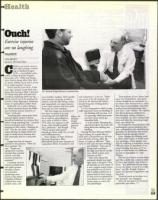
Dr. Richard Krugel discusses a strained knee.
Photo by Krim Husa
"Sixty percent of our clients have
and evaluation; I is for ice. "Make
torn Achilles' tendons. Both aerobic
some sort of problems. Any good
sure to ice it for 20 minutes, fol-
and resistance training, as well as
trainer should do an evaluation to
lowed by 40 minutes off, which
athletic activities like skiing, tennis
see where their fitness level is, what
should bring the swelling down,"
and racquetball, can cause injuries.
they want to accomplish, and what
says Nielsen.
Lower back injuries and knee prob-
medications and restrictions they
C
is
for
compression,
which
is
espe-
lems also are very common.
now have," says Nielsen. He explains
cially
important
if
you
are
bleeding.
If
The first thing you should do if
that blood pressure medications,
the bleeding will not stop, or if
you have an injury is to stop
beta-blockers, asthma inhalants,
it is spurting, which may mean
exercising and rest, followed Below: Dr.
even Sudafed, can alter resting heart
you have cut an artery, get
by ice and an anti-inflamma- Richard
rates and what the exercising target
immediate
help.
tory, such as Advil or Aleve.
Krugel
.heart rate should be.
E is for elevate. Elevating the
"If it does not improve in 48 examines a
He frequently communicates with
injured area above the heart will
hours, they should probably patient's
cardiologists,
sports medicine doc-
bring
down
the
swelling
and
see a physician," says Krugel. X-ray.
tors,
orthopedists
and rehabilitation
bleeding.
"Minor strains and sprains
specialists to determine the correct
During the first 48 hours follow-
should get better with rest, ice and
fitness levels for specific clients.
ing an injury, its a good idea to
anti-inflammatories."
Some changes are lifelong, such
stick with a 20-minutes on, 40-min-
Peter Nielsen of Peter Nielsen's
as those with cardiac or blood pres-
utes off cycle of icing. After 48
Personal Training in West
sure problems. Other people may
hours, it's time to add heat. "Heat
Bloomfield has an easy acronym to
only be suffering a temporary injury.
early
on
will
only
increase
swelling,"
remember: RICE. R stands for rest
"We then have to determine if we
says Nielsen. "Later on, it
avoid working that area, or if we
brings back nutrients
through your blood circula- need to work harder in a different
manner to strengthen it," says
tion, which is how your
Nielsen.
muscles are fed."
The key is to listen to your body,
Once your injury has
and
like a child who comes in after
recovered, should you head
he has a bad tumble, stop when it
right back to the gym? That
all depends on your injury. If hurts. "You definitely do not want
it was a simple muscle strain, to test the injury to see if it's really
hurt," says Dr. Krugel. A minor
you probably can. If you've
injury can become a significant one
had a cardiac problem or a
that way.
serious back or knee injury,
"Exercise needs to be done in a
it's best to be re-evaluated by
safe manner," says Simpson.
your doctor as well as a per-
After all, the goal is to be better
sonal trainer or other exer-
physically, not worse. 0
cise physiologist.
2/13
1998
113
Scanned image of the page. Keyboard directions: use + to zoom in, - to zoom out, arrow keys to pan inside the viewer.
February 13, 1998 - Image 113
- Resource type:
- Text
- Publication:
- The Detroit Jewish News, 1998-02-13
Disclaimer: Computer generated plain text may have errors. Read more about this.