

/-
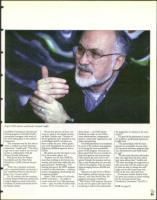
Project STaR's director and founder Armand Lauffer.
possibility of starting an international
training program in Israel for Jewish
community managers, with much of
the work taking place in the students'
hometowns.
"The consensus was for that idea to
work, it needed to include American
institutions," Lauffer said. "The advice
I got was to start small at my own uni-
versity, in collaboration with the
Detroit [Jewish] Federation."
With grants from the Wexner
Foundation and the Max Fisher
Foundation, Lauffer planned the pro-
gram.
"There was a receptive university
and a committed Jewish community. I
just would have liked to start the pro-
gram 10 or 15 years earlier."
The 32 students who have graduat-
ed from Project STaR have earned their
master's degrees in social work with a
certificate in Jewish communal service
and Judaic studies.
Ninety-five percent of them con-
tinue to work in the Jewish commu-
nal field, Sholder says. Thirteen of
the 32 graduates have decided to stay
in Michigan and five of those are
from outside the area. Other gradu-
ates work throughout the country at
federation-affiliated agencies and at
Hillels.
She points out that the degree is use-
ful in the broader sphere, too.
"Students can use their MSW for
more than working in the Jewish com-
munity, and that's what makes this pro-
gram practical," Sholder says. "The
training they get in the MSW program
is varied in what they learn — adminis-
tration, management, fund-raising and
interpersonal skills."
Project STaR consists of a 60-credit
MSW curriculum — 44 credits in
course work and 16 in field placement
work — plus 18 credits of Judaic study
courses. Of the 44 credits, nine — or
three classes — are STaR-related.
Students can major in one of four
areas: administration, interpersonal
practice, community organization, and
policy and planning.
The field placements are considered
by many of the students and graduates
to be among the more worthwhile
pieces of the program. First-year stu-
dents spend their first two months vis-
iting local agencies and interviewing.
They spend a day each week in the
agency through the semester, and two
days a week during their last year-and-
a-half in the program. They are paid a
stipend ranging between $3,000 and
$4,000.
"Agencies can take U-M or Wayne
State students without having to pay a-
stipend," said Dina Shtull-Leber, the
program's practicum coordinator.
"With Project STaR students, they have
to pay, but the agencyy-gs-o knows they
are getting a student who understands
the assignment in relation to the com-
munity."
The goal of the placements is to give
the students a professional experience,
Lauffer said.
"The partnerships with the local
agencies are invaluable, because there
are top-notch clinicians, program plan-
ners, administrators and fund-raisers,"
he said.
"We also insist that they take leader-
ship roles right from the start, which
may mean taking risks," Lauffer said.
"We often encourage the supervisors to
take some risks with the students and
let them do and try things that staff
might not be able to get away with.
Most of the time, they don't all."
Second-year student Andrew Echt,
28, spent last summer in Israel working
for the American Jewish Joint
Distribution Committee. The JDC is
STAR on page 83
2/6
1998
81