

1.1111.11111111111111111111.1111111......111111 1.1.1.11.101.11
Laurie Landers Goldman
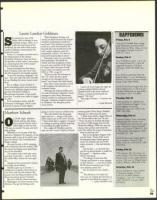
he caresses her circa 1742
Italian violin as though it were
a priceless antique. And it is. It
is also the instrument of her
livelihood, the tool with which Laurie
Landers Goldman communicates her
passion for music.
Laurie, 31, occupies a coveted seat in
the string section of the Detroit
Symphony Orchestra. From her front-
row position as first violin, Laurie enjoys
an uninterrupted view of the majesty
that is Orchestra Hall.
Laurie remembers her first lesson,
back in Kansas, when she was 4 years
old. She learned by the Suzuki method.
"It was like learning a language," she
says. "You start early and learn naturally,
by ear. Reading the music comes much
later."
But in college, Laurie decided to
study something much more practical.
She earned a bachelors degree in biolo-
gy, from Haverford College in
Pennsylvania, but came to the conclu-
sion that "I would never really be happy
in a lab."
So it was back to music, and the
University of Michigan, where Laurie
received a master of music degree.
"Both disciplines [biology and
music] are detail-oriented and require
complete concentration and focus,"
says Laurie. Her reluctance to pursue
music as a career was rooted in the •
fear that she never would land a job
with a major orchestra, since the
competition is fierce. "You have to
wait until someone dies or retires."
Obviously, Laurie is a rare talent.
Post graduation, she joined the
Toledo and Flint symphony orches-
tras and was a member of the Santa
Fe Opera. After two years of audi-
tions, Laurie was asked to join the
DSO in 1991, at age 25.
"There are only 20 orchestras in
the U.S. where the job is good
enough to stay throughout your
career," says Laurie, who feels blessed.
Since then, Laurie married, moved
to Birmingham and debuted as an
orchestral soloist.
Although she endures endless prac-
tice andperformance schedules, Laurie
manages to tutor Avery Elementary
School students in reading and math
through a volunteer program operated
by Hadassah. She also gives private
music lessons.
Matthew Schenk
going to see his name on a ballot soon.
"My wife thinks I like the gossip
aspect the best — being in the know,
before [issues are] in the news," he says.
"I don't think that's a negative. I'm good
at reading something quickly, analyzing
it and asking the right questions."
On a night off, Matthew opts for
take-out and a movie. People at Detroit
S
O
n Devil's Night, Matthew
Schenk and his wife, Jessie,
drove around Detroit with a
yellow light on the car roof
"We saw no activity," he says, and can't
help smiling.
Whether or not it's part of his job,
he'd do it. Matthew, 26, (esquire, on his
business card) is one of two policy ana- g
lysts for Detroit City Councilwoman ''
_J. , .
Sheila Cockrel.
He starts his day at 8:30, prepping .2
with Cockrel for the 9:45 session. Half
the issues (including casino gambling)
rest on his shoulders.
The session ends a little after noon
and then he sits back ... until 3, when
the clerk's office releases the next agen-
da.
Matthew's been interested in politics
since high school debate.
Matthew grew up in Detroit —
childhood in I A fayette Park (where he
now lives) and city-side Judaism (his
parents were founding members of the
Reconstructionist group T'chiyah).
But even with law school summers
in Washington, his heart remains in the
Midwest. You get the feeling you're
Laurie will never forget the night the
orchestra played Mahler's Second
Symphony and as the music reached a
climax, a woman in the second row
gasped, "My God."
The magic of music — it mirrors the
soul.
❑
— Linda Bachrack
watering holes (Town Pump, Franklin
Brewing Co.) know him by name.
"I think there will be a large influx of
20- 30-year-olds in the city," he says.
"There are plans to develop loft space
for about 15,000 people near the old
Hudson's building. [With two new sta-
diums, three casinos and several the-
aters] this will be the center of entertain-
ment to rival any city."
But it's not going to happen with-
out the basics. "Some of the newer
development plans include grocery
stores. It's certainly still one of the
major concerns — that and schools,
taxes."
Like his job — to "provide sup-
port for an elected leader, to make her
look good" — Matthew makes
Detroit look good.
"I've always viewed cities like
Chicago and Boston as more segregat-
ed than Detroit — a city that is about
80-90 percent minority, just 10 per-
cent majority, spread out."
But he insists he's not a leader ...
yet.
"My definition of a leader [is]
when you are making that decision, as
opposed to providing the support."
❑
— Lynne Meredith Cohn
2/6
1998
79