
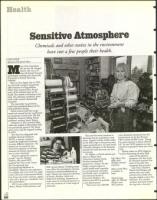

Sensitive Atmosphere
Chemicals and other toxins in the environment
have cost a few people their health.
LISA GAYLE
Special to The Jewish News
2/6
1998
us
Photo by Krista Husa
WI
arty Trice remembers
the day her life changed
forever. She was a 35-
year-old limited licensed
psychologist working with chronically
ill patients at Detroit Receiving .
Hospital.
Early on that August day in 1989,
an insecticide company sprayed her
office because of a bug problem.
When Trice returned later, she got
some of the chemical mist on her
hands. She started to fall asleep at her
desk. Her asthmatic condition, previ-
ously under control, dramatically
worsened.
The insecticide was pyrethrin,
made from powdered flowers of the
chrysanthemum family.
Poison control told Trice to get
tested and warned her she could devel-
op symptoms months later. She did:
headaches, frequent falling, kidney
problems, memory lapses, fatigue.
Unknown to Trice, another office
where she worked in Bloomfield Hills
was periodically sprayed. Her illness .
grew worse, and she stopped working
in 1994.
Trice has been diagnosed with
multiple chemical sensitivity
(MCS), a chronic condition
marked by heightened sensitivity
to many different chemicals. The
disease can be caused by one-
time heavy exposure or by lesser
amounts of chronic exposure to
one or more chemicals.
"Anyone exposed to a toxin is
at risk," says Dr. Michael
Harbut, who treats MCS
patients like Trice at the Center
for Occupational and
Environmental Medicine in
Southfield. "Based on my experience,
it's unlikely that a low level of a single
toxin will cause environmental illness,
but if you can smell a noxious, organic
odor and it gives you a headache, leave
the environment."
MCS is also called environmental
illness, Persian Gulf syndrome, and
20th century disease. Disabling symp-
toms affect the neurological, immune,
respiratory and musculoskeletal sys-
tems. Patients can experience shortness
of breath, dizziness, rashes and
abdominal cramping. Symptoms are
made worse by continued exposure to
even tiny amounts of a wide range of
chemicals.
new chemicals introduced into the
Trice now has severe reactions to
environment in the last 50 years.
chemicals that are used almost every-
We've
tested 20,000 or less. Testing
where. Cigarette smoke residue makes
for
cross
exposure is almost unheard
her ill. Short trips to the grocery store
of," he says. MCS patients are most
require premedication. An open bottle
sensitive to groups of these new chem-
of laundry detergent in the basement
icals.
beneath the room she rents can close
Harbut makes an MCS diagnosis
her airways.
by
first eliminating all other likely
Dr. Harbut, a clinical assistant pro-
causes of the patient's
fessor at Wayne State
rcy
Trice
symptoms. He then looks
Left:
Ma
University's medical school,
om
sufferst
suffers
for chemical exposure that
has been treating MCS
chemical
multiple
came at the same time
patients for 12 years. He also
sensitivi 1 Y.
symptoms first occurred.
holds a master's degree in
Like Trice, Charlotte
public health with a specialty Above: L inda Weiss
Merritt
had allergies and
in environmental and indus-
is health ier at
asthma
that were under
trial health and is certified by home.
control
until
a leaky heat-
the American Board of
ing
pipe
soaked
a rug in her
Preventive Medicine. He
Opposit e page,
basement.
The
cleanup
r.
Michael
right:
D
believes that MCS is probably
company she hired treated
Harbut treats
a new phenomenon.
the rug with a chemical
"There have been 600,000 MCS p atients.