

INEntertainment
This space contributed as a public service.
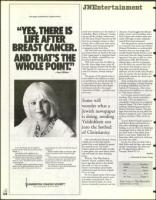
"YES,THERE IS
LIFE AFTER
BREAST CANCER.
AND THAT'S THE
WHOLE POINT:"
—Ann Jillian
small town ministry is in the midst of
imploding. Weary of Sonny's "wander-
ing eye and his wicked, wicked ways,"
his wife Jessie (Farrah Fawcett) has left
him for an associate minister at their
church. But to fully sever their union,
she follows up by strong-arming the
congregation away from him.
Left with little more than his tem-
per, Sonny shows up drunk at his son's
Little League game to drag Jessie back
home. He whacks a baseball bat into
her lover's skull instead.
With little more than the Bible by
his side, Sonny skips town, strips off
his past, baptizes himself with the alias
The Apostle E.F., and sets out on the
road to Louisiana, towards redemp-
tion.
The power of The Apostle is that it
leaves belief to the audience, its mati-
nee parishioners, and lets the deeds of
a man expose his true character. So
Duvall's hymnal Music Man shakes
and dances and sells a few people
instruments of faith — priceless ones,
to be sure.
Some will
wonder what a
Jewish newspaper
is doing, sending
Yiddishkeit out
into the hotbed
of Christianity.
A lot of women are so afraid of
breast cancer they don't want to hear
about it.
And that's what frightens me.
Because those women won't prac-
tice breast self-examination regularly.
Those women, particularly those
over 35, won't ask their doctor about a
mammogram.
Yet that's what's required for breast
cancer to be detected early. When the
cure rate is 90"0. And when there's a
1
6
2/6
1998
112
good chance it won't involve the loss of
a breast.
But no matter what it involves, take
it from someone who's been through
it all.
Life is just too wonderful to give up
on. And. as I found out. you don't have
to give up on any of it. Not work, not
play, not even romance.
Oh. there is one thing. though.
You do have to give up being afraid
to take care of yourself.
AAAERICAN CANCER SOCIETY
Get a checkup. Life is worth it.
And contradictions abound. Sonny
reaches out to the Lord and his
parish from a soul imbued by gospel
but stained by sin. The battle
between good and evil plays out like
a chess game; you never know which
side will make the final, deciding
move.
With his "One Way Road to
Heaven" church, complete with an
arrow sign that points to the clouds
(but with a U-turn as its base),
Sonny's waywardness seems finally
redirected toward the forces of good.
Or so we hope.
For every gentle stroke of the script,
every documentary-like camera move
and subtle acting flourish, there is
Robert Duvall to thank. As writer,
director, bankroller, producer and title
character, Duvall juggles the delicate
subject matter and storytelling with a
kind of grace and restraint more asso-
ciated with high-tea than celluloid's
typical Pentecostal caricatures.
And the guests he invites to partake
in it onscreen lend many rich textures:
Miranda Richardson, so authentically
Southern here you may forget she's
actually British; Farrah Fawcett, conti-
nents away from her dingy Letterman
appearance last year to pull out a fine
performance; Billy Bob Thornton,
adding bigot to his list of cinematic
ne'er-do-wells; the natural Rick Dial,
Thornton's close friend, co-actor in
Sling Blade and real-life furniture
salesman; and the terrific John Beasley,
who, for anyone who has doubts, sin-
glehandedly redeems the whole evan-
gelical profession.
Some reading this will wonder what
a Jewish newspaper is doing, knowing-
ly sending Yiddishkeit out into the
hotbed of Christianity, a film whose
only real nod to Judaism is a reference
to "The Frozen Chosen."
It is because movies breed under-
standing. They convert prejudices,
not souls. The Last Emperor is a
remarkably visual story of a toppling,
imperial Japan; The Color Purple is a
scathing, vindicating portrait of an
African-American woman. The mes-
sages they send out are not solely for
Asians or people of color. They teach
us about ourselves. They are for us
all.
To miss Robert Duvall's journey to
rural Bayou Boutt and beyond is to
miss some refreshingly crisp movie
making, in an era when it is becoming
increasingly hard to come by. Still, if
you don't want to hear about Jesus,
better to stay home. Triple-lock the
front door while you're at it. And pray
you don't have cable.
Let the rest of us run away with a
Holy Roller and his boxy, two-toned
Lincoln Continental. As a film over
all, The Apostle drives off in a
Triumph. Rated PG-13.
x:xx:xx:xx:x
— Reviewed by Susan Zweig
****
***
No Stars
Excellent
Worthy
Mixed
Poor
Forget It
Susan Zweig is a West Bloomfield-
based freelance writer.