
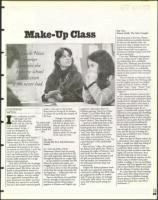

Make-Up Class
mother, who came to the United
States
alone at the age of 16, became
StaffWriter
an atheist the moment she stepped off
the boat.
have a confession to make:
Perhaps I had spiritual
Although I am The
yearnings, or perhaps it's
Jewish News education
The author takes just that we always want
writer and am a Jew by
notes in Sheila
what we don't have, but as
birth, I never attended
Mertz's
third-grade
a child I always secretly
Hebrew school. In fact, I
class at Temple Kol wished I could go to
could not distinguish an
Ami.
Hebrew school. At the age
aleph from a bet until my
of 26, I got my wish:
junior year of college when,
armed only with the word "shalom," I
Day One,
walked into my ulpan (intensive
Temple Kol Ami, Ealy Elementary
Hebrew class) at Tel Aviv University.
School
Inspired at first by a desperation to
understand what people in the coun-
As I enter the lobby of Ealy
try around me were saying, I spent the
Elementary School, kids are buying
next few years obsessively trying to
candy and other junk food from Kol
catch up, finally getting to the point
Ami staff, apparently planning to get
where my conversational and compre-
through the long day on a sugar high.
hension skills surpassed the average
As the students are herded into the
Hebrew school graduate.
library
for prayers and music, one
How did I avoid the rite of passage
straggler
runs to the candy table and
other Jews of my generation so love to
— as if he is about to miss the parting
complain about? My father, who was
of the Red Sea and get drowned with
forced to attend Hebrew school as a
the Egyptians — desperately calls out
child in New York, developed a strong
"Don t close! Don't close!"
distaste for religion. And my mother
Once in the library, the assembled
was a generation removed from reli-
fourth-
through seventh-graders say
gious observance: her father was born
the
Barchu
and the Sh'ma prayers
Orthodox but rejected it, and family
together
in
Hebrew and English, par-
lore has it that mom's maternal grand-
JULIE WIENER
I
/-'
'
ticipate in a discussion about Tu
B'Shevat and sing "Eretz Zvat Halav
v'Dvash" ("Land Filled With Milk
And Honey"), which corresponds to
the week's Torah portion. After a col-
lective "Aleynu," they head for class.
I pull up a child-sized chair to the
child-sized table in Sheila Mertz's
fourth-grade class. Students are prac-
ticing reading words with the letter
"ayin" from their brightly colored
workbooks. Mrs. Mertz then moves
on to some conversational Hebrew,
with children learning how to say "I'm
a good boy/girl" ("Ani yeled/yeldah
tov/tovah")..
After an hour, I skip a few grades to
Stu Raban's sixth-grade class, which is
discussing the reigns of Solomon, Saul
and David. For the most part, the
boys are following the discussion and
the girls are slouching their newly
teen-age bodies, lost somewhere on
the continuum between sleep and
consciousness.
Despite Mr. Raban's pleasant teach-
ing style and a genuinely interesting
conversation clarifying why BCE years
get progressively smaller in number
and CE years get larger, the lethargy
of the girls' table where I sit is infec-
tious, and I find myself eyeing the
clock.
Day Two,
Shaarey Zedek, The Laker Complex
Like their peers at Kol Ami, Shaarey
Zedek's students are probably destined
for hours in the dentist's chair: the
brand-new Laker Complex boasts two
brand-new vending machines, and
Hebrew lessons here occur against a
backdrop of rustling wrappers and bub-
ble gum-chomping.
I join Mrs. Weisberg's third-graders,
who are sitting around a table practic-
ing reading from their workbooks.
Despite Mrs. Weisberg's post-bronchitis
soft voice and the relatively large size of
the class, the children are remarkably
well-behaved and enthusiastic, listening
eagerly to their teacher's calm and quiet
instructions.
Then it's time for an informal vocab-
ulary quiz, in which Mrs. Weisberg calls
out the English word and the children
supply her with the Hebrew. Words
include "wine," "water," "family," "you"
(both masculine and feminine) and
"Hebrew."
After about an hour, I venture over
to Mrs. Goodman's seventh-grade class,
which starts out with a discussion about
Auschwitz's Dr. Mengele and then Mrs.
Goodman reads them a story about a
black teen-ager lynched in the 1950s
South. The somber topics do not
appear to interfere with a group of girls'
industrious note-passing and chattering,
although when Mrs. Goodman warns
of the dangers of ink on skin, one girl is
aroused to such a panic that she spends
the rest of the period scrubbing her
hands noisily in the classroom sink.
And then the day is over. I make my
way through the crowd of waiting par-
ents, past the line-up of waiting car-
pools, past a childhood that I missed
the first time around.
After two days of Hebrew school, do
I still long for what might have been? A
little. I would have liked that feeling of
belonging that knowledge brings,
would have liked to know at the time
that being Jewish was about more than
bagels, lox and the Holocaust. But I
also feel lucky that my lack of early
education whetted my appetite, so that
when I came to Hebrew and Judaic
studies in college, it was not something
I resented. And I feel grateful that I was
able to learn Hebrew while surrounded
by the vibrancy of modern-day Israel.
So, I just hope the always-wanting-
what-I-don't-have thing doesn't hap-
pen to my allure children, because
they're going to Hebrew school. No
matter how much they may whine
and kvetch.
1/30
1998
89