

being struck by the intensely negative
feelings harbored by many of the par-
ents she dealt with. "The first comment
I used to hear from parents was, 'I hated
Hebrew school. What's yours like?'" she
says.
She speculates that many have been
pleasantly surprised. One Kol Ami par-
ent, Howard Dembs, is reluctant to talk
about his own Hebrew school experi-
ence, but is convinced his son, Brad, has
it better. "There seems to be more com-
munity involvement and projects to get
the kids involved," he says. "It's more
creative now."
Karen Lowen, another Kol Ami par-
ent, agrees. "They're so involved, and
we're more involved as a family. It's
more family-oriented, and kids have a
better understanding of what they're
learning. Questions are encouraged."
"I think the kids don't have that
awful negative attitude like they used to -
have," says Rita Abramson, director of
education for Congregation B'nai
Moshe, which launched a Shabbat
school in 1992.
Shaarey Zedek parent and graduate
Denise Weisman thinks Hebrew school
provides more outlets for creativity now
"I like the artsy stuff they bring home,
like menorahs and kiddush cups they've
made," she says. "When I was in
Hebrew school it was always book,
book, book reading. This is a big change,
— it makes it fun.
"When I went to Hebrew school in
the 1950s, most of the teachers were
using teaching methods from 30 to 40
years earlier," says Allen Goodman of
Beth Shalom. "We sat in class, read the
book and answered questions. Sara
[Allen Goodman's daughter] comes back
talking about what's in the parsha and
gets excited about Hebrew stories."
Mark Littman, also of Beth Shalom,
thinks his children are more comfortable
following services than he was. "I dis-
tinctly remember sitting on the bimah
on the day of my bar mitzvah," he says.
"The rabbi said, 'The eyes of the con-
gregation are upon you: daven.' And I
didn't know what to do. I didn't even
know what the Musaf[service] was."
Improvements are occurring nation-
wide, says Ron Wolfson, vice president
of the Los Angeles-based University of
Judaism,He attributes much of the
change to better teacher training and
greater availability of educational
resources.
"Twenty years ago, there was no
place for the average teacher to get pro-
fessional development," says Wolfson.
Now there is the annual Coalition
for the Advancement of Jewish
Education (CAJE) conference, as well as
local workshops, such as the Agency for
Jewish Education's NIRIM programs for
teachers.
Wolfson praises synagogues for fami-
ly education and other efforts to ensure
that Hebrew school learning is rein-
forced at home.
While improvements have been
made, the Hebrew school model contin-
ues to face challenges. And with no
studies assessing parental and student
satisfaction, it is difficult to determine
whether parents who rave about
Hebrew school are typical or just more
involved in their children's education.
Wolfson concedes that the very struc-
ture of Hebrew school can be problem-
atic: "It's very difficult for kids to spend
the whole day at public school, then
come for additional hours of instruction
at the end of the day." -
Cecile Jordan, chair of the
Association of Directors of Central
Agencies for Jewish Education (Detroit's
AJE is a member of this group), is over-
seeing a national initiative to improve
Hebrew school. Members of the associa-
tion are brainstorming proposals to pre-
sent at a March meeting. The plan is
then to launch pilot projects around the
country.
"A lot of Hebrew schools have
changed a lot, but what we have in
many situations are parents who are
both working and busy. We also have
lots of children from divorced and inter-
married families, which can be diffi-
cult."
While parents appear to be more sat-
isfied with their children's education,
what do their children in the trenches
have to say? Conversations with stu-
dents at Temple Kol Ami and Shaarey .
Zedek reveal mixed results.
When asked whether she likes
Hebrew school, Carly Katz, a Kol Ami
sixth-grader, says "I come and I learn,
but it's not like I enjoy it." Her friend,
Jamie Hillenberg, agrees.
But Kol Ami fifth-grader Jeff Taxe
says, "To tell you the truth, it's not bad.
Sometimes I like it and sometimes it's
boring. Today was good. I think I learn
a lot here."
Shaarey Zedek seventh-grader Lauren
Zeid is ambivalent. "It's boring, but
some of the classes are okay."
Of course, it's often hard to assess the
quality of education until it's over.
"Sunday school is one of those expe-
riences that you don't realize you are
enjoying until many years after you have
finished," says Sharon Kresch; whose
children attend Beth Abraham Hillel
Moses. 0
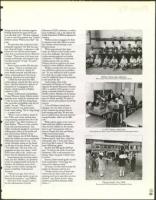
Hebrew school date unknown.
Photo courtesy of the Jewish Federation of Metropolitan Detroit.
A 1967 Hebrew school class.
Photo by Bei;iard H. Winer, courtesy of the Jewish Federation of Metropolitan Detroit.
Playing outside, circa 1964.
Photo courtesy of the Jewish Federation of Metropolitan Detroit.
1/30
1998
85