

roommate, he could afford a little
Royal Oak fixer-upper.
"I loved working on it," says
Rosenblatt, a corporate imaging exec-
utive who spent weekends making
cosmetic changes — painting, paper-
ing and changing carpet. After a year
and a half, he sold and pocketed a tidy
profit. Enough to buy a house in
Huntington Woods for himself and
his fiancee, Debbie Mindell.
The only negative, accord-
ing to Rosenblatt, is the fear
factor. What if the furnace
gives out or the windows leak?
But pride of ownership quelled
his worries.
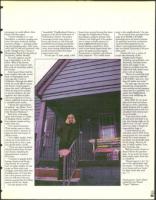
Artist Laurie Mazer had the
same mindset when she moved
back to Birmingham seven
years ago after a stint in
California. Although she didn't
think she could afford a house,
she found a small bungalow
where she could "self-express."
With the help of her mother,
an interior designer, the pair
applied a few coats of paint
and some ingenuity to turn a
dreary, neglected structure into
a veritable artist's studio.
"I feared the responsibility
of upkeep," says Mazer, "but I
have no regrets. I have my own
little Peewee's Playhouse."
Ruth Levi, a real estate
agent with Century 21 Today
in Bingham Farms, outlines
four primary reasons to buy,
rather than rent.
* It's a good investment.
With interest rates at a four-
year low, below 7 percent, it's
easier for first-time buyers to
afford a home.
* It's a seller's market. Prices
will go up. If you hold on to
your house for at least a year,
you should realize a profit.
* There are some wonderful
federally-backed loans for first-
time buyers, including the
aforementioned 3 percent
FHA loan.
* Contrary to popular belief,
buying a house is not like get-
ting married. It's not perma-
nent. In today's market, it's easy
to get out from under your
mortgage, sometimes easier than
breaking a lease. So if you hesi-
tate to buy because you're not
sure you will stay in the area,
chances are good that the selling
process will not be a hassle.
Levi also points to the
"remarkable" Neighborhood Project, a
program of the Jewish Federation of
Metropolitan Detroit. The project
encourages Jewish home buyers to
locate and remain in Oak Park and
Southfield by providing interest-free -
loans, contacts with lending institu-
tions, home-buying information and a
newly-initiated interest-free home
improvement loan.
For the past 11 years, nearly 1,000
buyers have received interest-free loans
through the Neighborhood Project.
According to program assistant Amy
Neistein, the initial goal of the project
was to ensure a Jewish presence in
these neighborhoods-and to keep
Jewish families rooted there. Now,
with its new home improvement pro-
gram, the pioject is encouraging
homeowners to maintain and enhance
their properties. "It' -a visible invest-
•
•
•
nr
•
•5-4, a•,,,,:q.,?,:i4rif:d '9
"
ment in the neighborhoods," she says.
The incentive home purchase loans
range from $6,000 to $10,000,
depending upon the home's location.
An applicant must have a minimum
5-percent down payment to con-
tribute. Loans are interest-free and
may not exceed 10 percent of the pur-
chase price.
Neistein has seen a variety of
people take advantage of the
Neighborhood Project,
including young families, new
Americans, first-time home
buyers and singles. It has
helped to revitalize areas like
north Oak Park, where home
prices now are soaring.
"Homes in north Oak Park
range in price from $90,000
to $190,000," says Levi, "and
they sell within two weeks."
Ten years ago, the area was
floundering, young families
were moving out and property
values were at a standstill. Levi
credits the Neighborhood
Project with solidifying the
community.
Marc Wolf, 27, sees both
sides of the buy/rent debate.
By day, he owns a plumbing
supply business and by night,
on weekends and on-call, he's
a landlord with rental proper-
ties in Ferndale.
"If you don't have a stable
job and aren't tied down to an
area, then buying might not be
right for you," he says. 'And if
you're not ready to handle the
responsibility, forget it."
It really depends on the
individual, reasons Wolf. Some
young people may have enough
money for a down payment,
but they're not financially ready
for the plunge. However, he
says, in today's market, if you
have the bucks, buy.
Wolf has owned a home in
Royal Oak for the past four
years. As an owner, he knows
what people expect from him
as a landlord.
"Mutual respect is key," he
says of his relationships with
his tenants. "I tell them, 'This
is my house and your home.'
I'm there when they need
me." ❑
Purple passion: Laurie Mazer
created her own Peewee's
"Purple" Playhouse.
1/30
1998
81