
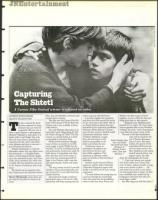

A Cannes Film Festival winner Is released on video.
MORRIE WARSHAWSKI
Special to The Jewish News
T
he lost world of the shtetl
has been explored in many
mediums but can never be
recaptured. We can view it
from a quiet distance in photographs
(Roman Vishniak) or read about it in
books (Life Is with People). But only
film can come close to providing an
experience for the viewer that melts
away distance and time to reinvent a
part of history lost forever.
Yolande Zauberman is a French
filmmaker whose first two efforts were
documentaries — Classified People,
about a South African family caught
up in the apartheid system, and Crim-
inelle, about members of a rebel tribe
in India. She has rooted her concerns
in the themes of tolerance and accep-
tance.
We should not be surprised, then,
that Zauberman's first dramatic feature
Morrie Warshawski writes about cul-
ture and the arts from his home in St.
Louis.
film, Ivan and Abraham, continues and
extends these interests.
The film won the Cannes Film Fes-
tival 1993 Camera D'Or for Best First
Feature and is now available in home
video format.
Ivan and Abraham takes place in an
ethnically mixed village along the Pol-
ish border during the 1930s. The film
centers on a Jewish family in a shtetl
surrounded by Christian Poles.
All the Jewish characters (though
none of them are Jewish in real life)
were taught to speak Yiddish just for
this film. To aid in its feeling of period
and authenticity, Zauberman made the
bold choice of using black and white
film. She shot most of the scenes in
one of the few remaining Jewish vil-
lages in the Ukraine, with a cast that
also spoke Russian, Polish and Gypsy
dialect.
The story centers around 9-year-old
Abraham (Roma Alexandrovitch) and
his non-Jewish 12-year-old friend Ivan
(Sacha Iakovlev).
Alexandrovitch brings a freshness
and impish vigor to his role of a little
Jewish boy who hates praying and just
wants to go out and ride horses.
Rachel, who plan to go to France
Ivan knits together the characters
together, set out to find the boys and
bring them back to their parents.
and plots that swirl around the events
Along the way, Abraham must
of just a few days in his shtetl. His sis-
ter Rachel (Maria Lipkina) has been
pretend he is a Gypsy. He meets super-
stitious peasants who accuse Abraham
betrothed by her tyrannical grandfather
Nachman (Rolan Bykov) to marry a
of being "the devil," and is bequeathed
a foal when he nurses it back to life.
man she does not love. Rachel's exiled
The end of the film-foreshadows
Communist boyfriend, Aaron
what will lie ahead for the
(Vladimir Machkov), escapes
rest of Eastern European
from jail and returns to the
Sacha Iakovlev plays
Jewry in just a few years.
shtetl to say goodbye to his
Ivan and Roma
father and reclaim his love.
Alexandrovitch plays Indeed, the specter of the
impending Holocaust hov-
Zauberman creates an
Abraham in
atmosphere of explosive ten-
Yolande Zauber- ers over every scene in the
sion between the Jews and
man's "Ivan and film. Zauberman did a great
deal of research before writ-
their Polish neighbors. This
Abraham."
ing her script. She talks
sensitivity to character makes
about the photographs she found.
each one feel like a flesh-and-blood
"... I saw eyes, strong eyes, people
individual.
who didn't realize how unique they
Rachel's mother Reyzele (Helene
were. In short, ordinary people. I imag-
Lapiower) and her father Mardoche
ined a story based on them .... My
(Alexandre Kaliaguine) appear only
only desire was to stick to my charac-
briefly in the film and yet leave strong
ters and remain close to them. As their
impressions.
story unfolded, they would end up
The story follows the young boys on
bringing in with them the echo of a
a journey through the countryside
when they learn that the grandfather
much larger world."
Her film rings true with this echo. ❑
wants to take Ivan away. Aaron and